Back to News
Latest news
Maeil Kyungjae
An abandoned semi-basement home is transformed into an urban-style warehouse
A semi-basement in a building somewhere in Seoul. A space that had been left abandoned, becoming a ruin because no one had lived there for a long time in a dilapidated building, has recently been transformed into a neat private storage facility for personal belongings.
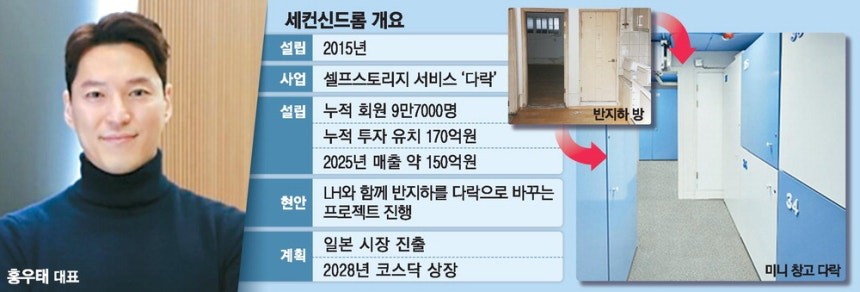
The company that made this possible is Second Syndrome, which operates ‘Mini Storage Darak’. In fact, last year Second Syndrome, together with the Korea Land & Housing Corporation (LH), converted four semi-basement homes in Seoul into Darak locations and received favorable reviews.
Hong Woo-tae, CEO of Second Syndrome (photo), said in an interview with Maeil Business Newspaper, "Because semi-basements have several limitations such as moisture, ventilation, safety, and psychological resistance, we reviewed structural safety, waterproofing conditions, the possibility of condensation, ventilation conditions, and other factors, and carried out the work only in spaces that could meet storage-environment standards."
Founded in 2015, Second Syndrome is a lifestyle infrastructure company that provides 'flexible space options' to idle facilities in the city center. It is a concept similar to an 'offline cloud storage space.' It offers an integrated urban space subscription service based on mobile application (app) non-face-to-face use, 24-hour access, temperature and humidity management, security systems, insurance, and damage compensation.
CEO Hong said, "Many people dream of 'owning a home,' but for most people, not only is home ownership out of reach, but the burden of housing costs keeps rising every year," adding, "I founded the company because I thought that if there were an additional space option beyond the home, it could greatly improve residential satisfaction."
At the time of its founding, self-storage services had no legal or institutional definition in Korea. Because interpretations differed from one local government to another, the industry itself remained unstable as some areas allowed operations while others restricted them.
In 2023, Second Syndrome became the first in Korea to receive an information and communications technology (ICT) regulatory sandbox designation, laying the groundwork for self-storage operations, and proved its growth potential and necessity over two years.
Last August, those efforts finally paid off. The Ministry of Land, Infrastructure and Transport revised the Enforcement Decree of the Building Act to newly establish the use of 'shared storage facilities' within neighborhood living facilities. CEO Hong said, "After the institutional reorganization, local governments, building owners, financial companies, and investors all came to recognize this industry as an infrastructure industry, and since then the pace of growth across the market has felt distinctly faster."
Darak's differentiating factor is that it maximizes user convenience and safety. Users can access their own cloud space 24 hours a day without going through a manager, and temperature and humidity are managed uniformly during sleeping hours. If it is difficult to visit an offline location, they can also send or receive items from home through logistics services.
It established design standards based on actual risks such as leaks, condensation, fire, and security, and built an operation process centered on prevention. It also has insurance and an internal compensation system in place to prepare for accidents.
In line with the AI era, it also made it possible to prevent accidents through an operating system that connects each branch's temperature and humidity, access records, and signs of anomalies to data based on AI technology.
CEO Hong said, "Thanks to AI technology, Darak can maintain stable space quality 24 hours a day without an operator on site, and customers can use it freely at any time through the mobile app."
Darak's cumulative membership has reached 97,000. Recently, as one-person businesses and side jobs have increased, the share of use by corporate businesses, small merchants, and sole proprietors has also been rising.
Thanks to these efforts, it attracted a cumulative investment of 17 billion won, and sales in 2025 recorded about 15 billion won. It aims to be listed on the KOSDAQ market in 2028.
[Reporter Lee Ho-joon]
Reporter Lee Ho-joon (lee.hojoon@mk.co.kr)