insight

Hong Woo-tae, the representative of DaLock
In the previous article, we looked at using self-storage as a way to solve the vacancy problem in knowledge industry centers, which has recently emerged as a social issue. In particular, we covered how well knowledge industry centers and self-storage can match from three perspectives: location, convenience, and profitability. In this article, we will take a look at self-storage from the perspective of real estate development and investment. After examining examples from advanced countries where self-storage has developed, we will look at its potential in the domestic market.
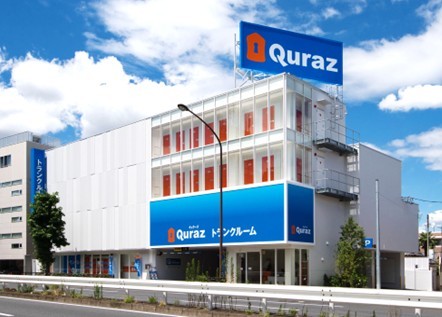
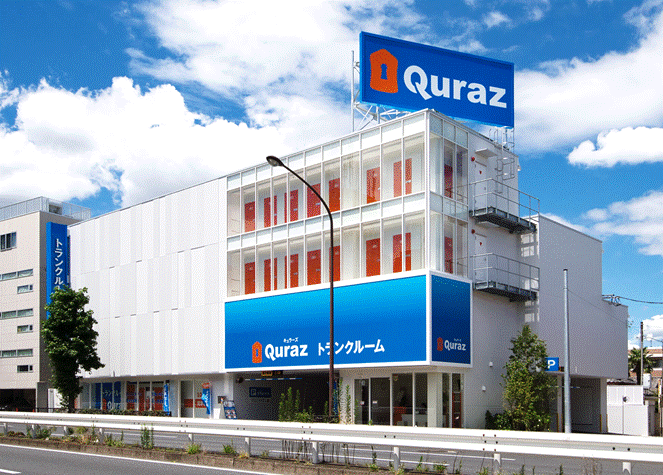
<Japanese Quraz trunk room / Source: Quraz>
The Growth Ecosystem of U.S. Self-Storage
Looking first at the United States, the birthplace of self-storage, there are about 52,000 storage facilities in operation—more than the total of Starbucks, McDonald's, Dunkin' Donuts, and Wendy's combined. The average facility size is also as large as 2,000 to 3,000 pyeong, which is quite substantial.
With a Penetration Rate of 10%, meaning 1 in 10 households uses it, self-storage has become so mainstream that facilities are being built not only by specialized corporations but also by individuals. Just as Korean retirees once opened fried-chicken restaurants, there are many cases in the U.S. where retirees buy land in quiet areas, build self-storage facilities, and rely on them for retirement income.
There are two major forms of self-storage development. One is an Opportunistic strategy, where existing buildings in urban areas are remodeled into self-storage, and the other is Development, where land is bought in surrounding areas and a building is constructed.
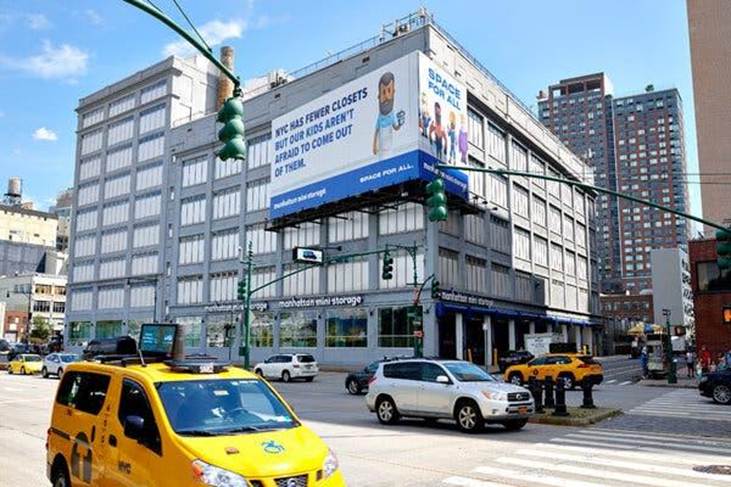
A representative case of remodeling in the city is Manhattan Mini Storage. Founded in 1978, the company is based in Manhattan, New York, the world's most expensive land market, and owns 18 facilities. It used creative marketing strategies well, and due to successful operations was acquired by Storage Mart in 2021 for more than $3B.
Despite its name, the deal size is not mini. Although the building price when they acquired it likely wasn't cheap, they seem to have achieved successful real estate operations by maximizing operational finesse, much like the dynamic pricing used by Darak.
When I personally visited the facility in New York's East Village, I was impressed by how they had created several loading docks in the middle of the city so cargo trucks could enter. Some people sometimes ask whether self-storage can only operate in rural areas, but that shows a misunderstanding of the business. Our Darak also operates 80 sites in Seoul, a megacity.
<Manhattan Mini Storage / Source: Manhattan Mini Storage>
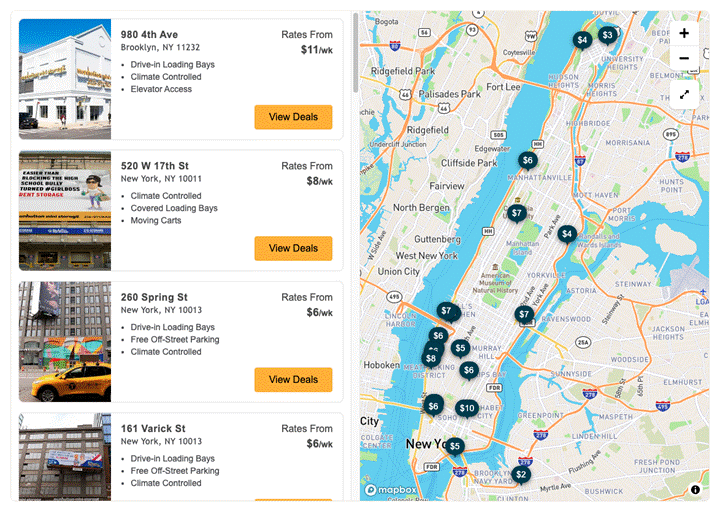
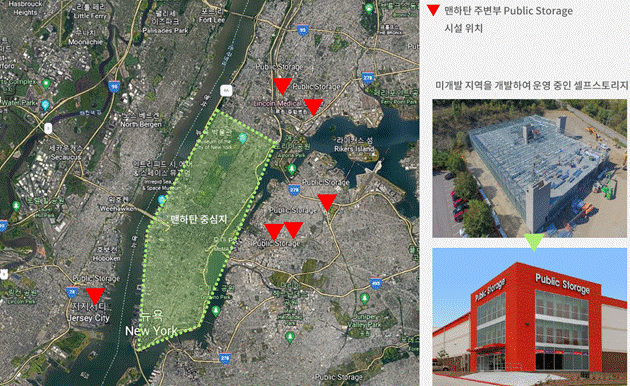
Development of self-storage—buying raw land and building a facility—is also often carried out by medium and large corporations as well as individuals. It tends to target areas around the city rather than the city center, and if you visit a self-storage development site, you'll be amazed at how bare the land is.
That's because people are not the main traffic; it's luggage and goods that move through these places. So there is no need to build on expensive land with high foot traffic. This is one of the features that distinguishes the self-storage sector from residential or office.
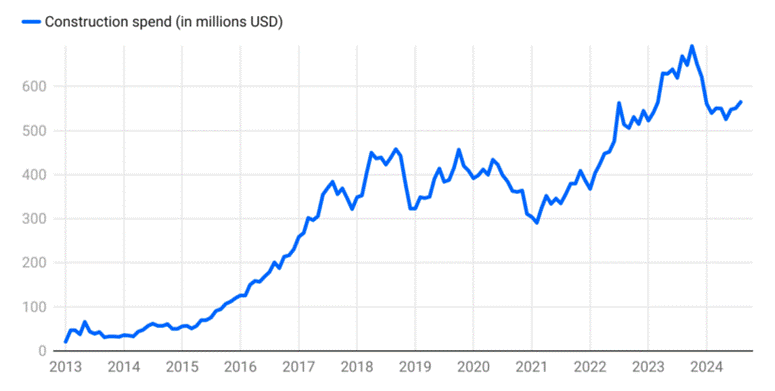
Also, even in a mature market like the U.S., self-storage development remains active in the long term. I haven't seen this year's data yet, but from the early 2000s through last year, U.S. self-storage construction spending has steadily increased, and since the pandemic it has become even steeper.
<U.S. self-storage construction spending / Source: U.S. Census Bureau>
Secondly, construction cost is low. For the same reason, because self-storage is not where people stay, construction costs are far cheaper than in other real estate sectors that require extensive interiors and finishing materials. If housing construction cost in the U.S. is around $1,080 to $2,160 per square meter, self-storage is around $270 to $810, so it is roughly less than 50% as expensive.
If you're confident in operations, you can cover interest costs with cheap land and low construction costs while also earning real estate investment returns.
<Self-storage development example on the outskirts of Manhattan / Source: Second Syndrome>
If you want to realize real estate returns, these developed self-storage facilities need to be sold—so who buys them? This is where the interesting side of the self-storage ecosystem comes in. Self-storage is fundamentally a local business. Just as large conglomerates in Korea may own many real estate assets but cannot own all the land, self-storage cannot be dominated by a few players and tends to be fragmented.
As a result, capital-rich players end up buying up self-storage facilities developed one by one. That's why M&A in the self-storage industry happens very frequently. Buyers can be self-storage companies, but also insurers, pension funds, private equity funds, and REITs.
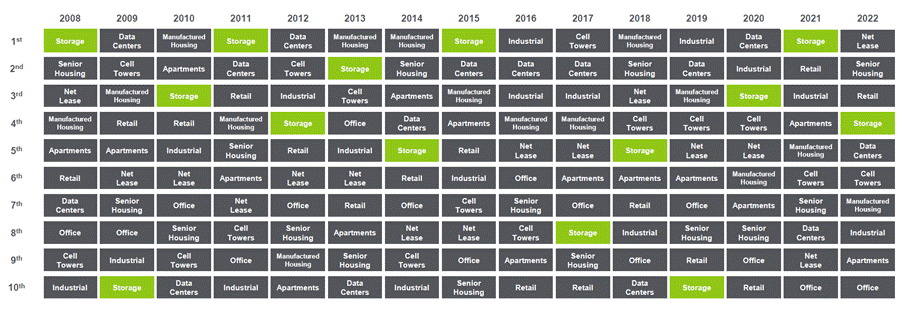
They are all giants of the capital markets seeking stable returns. For example, self-storage accounts for about 8% of the U.S. REIT sector, on par with data centers, so it can be seen as a proven sector.
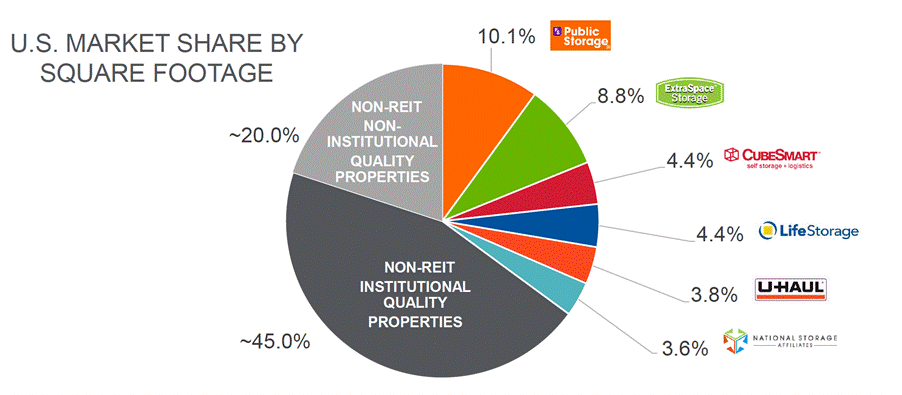
<U.S. self-storage market share by area / Source: Extra Space Storage>
The Rise of Real Estate REITs
When discussing self-storage, REITs are another essential piece. In the chart above, Public Storage, Extra Space Storage, CubeSmart, and National Storage are the four major listed self-storage REITs. What stands out is that these listed REITs are delivering higher returns than traditional real estate assets such as residential and office. Because returns are high, dividends tend to be generous as well. Over the past year, these REITs recorded dividend yields (Trailing Annual Dividend Yield) of 3.56%, 3.93%, 4.20%, and 5.17%, respectively.
These REITs are massive. Looking at the number one, Public Storage, its market cap is $58B, which in KRW is over 81 trillion won, and if brought into the KOSPI market, it would rank 4th. Last year's revenue was $4.5B and operating profit was $2.3B, giving an operating margin over 50%. Even more impressive is a Same Store NOI margin of 78%. These figures seem possible because it has more than 3,300 operating facilities.
Another interesting point is that these REITs are REITs themselves, but also developers, asset managers, and operators that directly run self-storage. In most cases, they either started as REITs investing in or developing real estate and later moved into operations, or they internalized operating capabilities by acquiring specialized operating companies.
One can also say that the Prop-co & Op-co structure, currently gaining attention in overseas real estate investment, has expanded into REITs.
< U.S. REIT-listed real estate sector return ranking / Source: Extra Space Storage>
Current Status of Self-Storage Development in Japan
Leaving the glamorous U.S. market behind, let's look at Japan, a neighboring country and also a benchmark for Korea. In Japan, there is a mix of franchise-style self-storage occupying one room or one floor of a building, and facilities that take up an entire building. Of the roughly 15,000 self-storage facilities, about 8,000 are Outdoor facilities classified as container types. This is because in central urban areas floor-by-floor facilities have emerged, facilities occupying entire buildings have appeared in suburban areas, and outdoor facilities are located in the outskirts of the city.
Last October, I visited Japan for meetings with Japanese companies, and I was able to encounter various types of self-storage facilities while walking the city streets. In Korea, for example, it was not uncommon to see the first floor of a three-story mixed-use building used as self-storage, almost like a laundromat, and 10-story-plus buildings openly occupying a spot with prominent front signage.
Recently in Japan too, the share of self-storage developed through development has been increasing. Development was pioneered by large companies such as Quraz, founded in 2001, and as a result Quraz was fully acquired by Evergreen Real Estate Partners in 2013.
From about five years ago, small and mid-sized developers entered the self-storage development market and are currently driving it very actively. They are not listed REITs like those in the U.S., so they don't have the same capital strength, but they typically carry out projects using PF loans and also handle operations after completion. They hold some assets long term to target capital gains directly and liquidate others through sales.
Recently, self-storage development in Japan has been taking on a very stable shape, with acquisition commitments from pension funds, insurers, or global self-storage companies secured even from the land purchase stage and used for PF.
<Arealink's self-storage facility classification method in Japan / Source: Arealink>
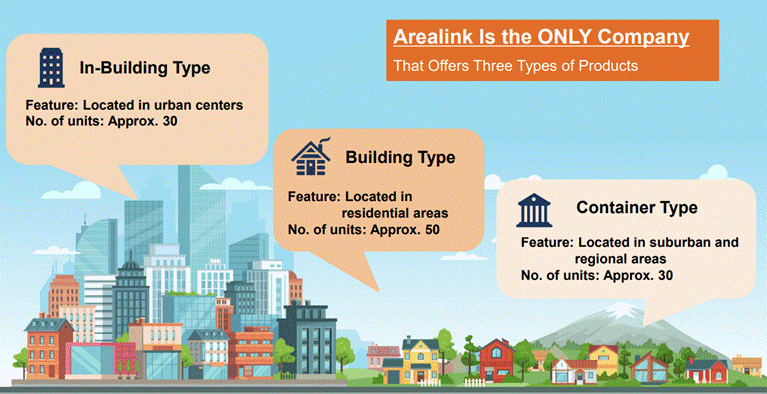
Arealink, which operates Hello Storage, Japan's leading self-storage service, is a real estate business company established in 1995. Based on the brand recognition of Hello Storage, Japan's No. 1, Arealink is developing a profit model through direct investment.
Storage Mini, launched in 2022, redevelops a three-story building on a site of about 100 pyeong into a facility optimized for storage, and it has been steadily expanding in areas with populations of more than 100,000 outside the metropolitan area. Of these, so far 9 locations have been sold to investors together with the land, generating additional development profit.
A notable feature of self-storage development in Japan is the many cases of remodeling entire buildings—from small buildings or houses to large commercial buildings—into self-storage facilities. It seems to be part of a strategy to increase the value of real estate assets while covering leverage costs with operating income. These facilities are representative examples showing that in Japan, self-storage has become established not merely as a goods-storage service but as a segment of real estate development.
Also, even Japanese conglomerates such as Mitsubishi, which grew through real estate development, are planning to develop smaller plots into self-storage as residential and office development reaches saturation. As our Darak also continues discussions with them as a specialized operator with automation technology, we may soon see a Mini Storage Darak signboard in Japan.
<Japanese self-storage facility remodeled from a residential building / Source: Storage King>
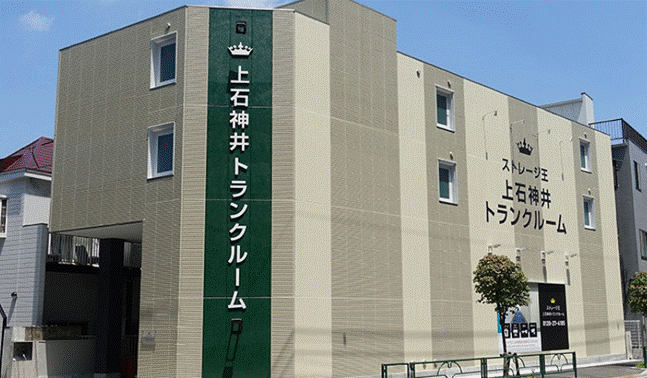
The Potential of Domestic Self-Storage Development Business
As seen above, in the U.S. and Japan, self-storage is being used as a means to maximize real estate value. In particular, we can see that the burden of financing is being reduced through partnerships with REITs and asset managers.
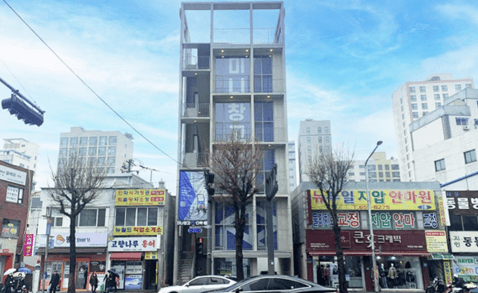
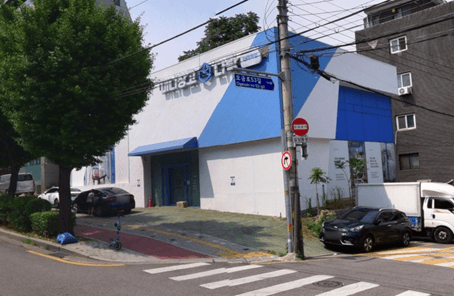
Darak, which is leading the domestic market, is also increasing real estate value by converting entire buildings into self-storage facilities. Darak Bucheon Station branch converted an entire 5-story building located near the station, and Darak Geoyeo Station branch converted two standalone floors that had been a model house into self-storage, recording high profitability. In a weak retail real estate market, these are cases where buildings that had difficulty attracting tenants or had no suitable use were transformed back into income-generating real estate.
<Darak Bucheon Station branch and Geoyeo Station branch / Source: Second Syndrome>
Moreover, Darak is preparing a more sizeable development project. It is proceeding with expected return projections and planning/design for developing self-storage on a site of more than 1,000 pyeong in the outskirts of Seoul.
The reason Darak can operate relatively large facilities is that, with its 140-odd branches expanding actively by site, it can absorb existing demand, and it is the only operator in Korea with an automation platform. It appears that full-scale discussions with various asset managers and overseas LPs interested in domestic real estate investment will begin.
<Self-storage planning and design / Source: Second Syndrome>
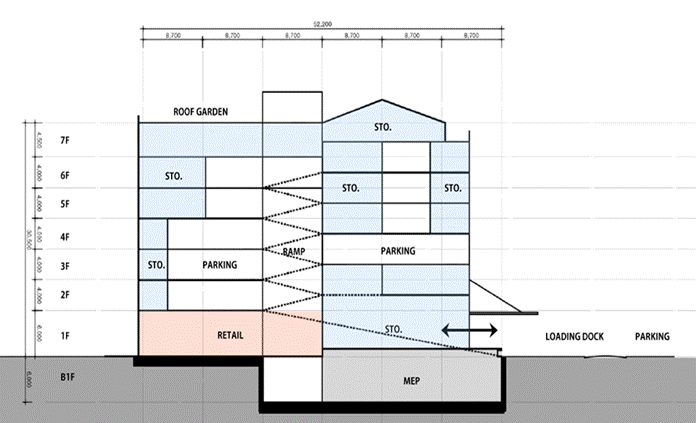
One welcome piece of news is that this June, in a press release titled <Measures to Revitalize REITs for Increasing National Income and Advancing the Real Estate Industry>, the Ministry of Land, Infrastructure and Transport announced a plan to expand REIT investment targets to various future-growth sectors such as healthcare and data centers. Currently, REIT investment is only possible in specific assets listed in the Real Estate Investment Company Act, but now investment will be possible in various assets approved by the Ministry of Land, Infrastructure and Transport.
This can be seen as opening a path for the approximately 98 trillion won in domestic REIT assets to flow into self-storage investment.
Moreover, recently the National Pension Service, one of the world's top three pension funds, announced its plan to select entrusted managers for domestic real estate investment and included self-storage as a New Business in its 750 billion won real estate investment fund target. As self-storage firmly establishes itself as a domestic real estate sector in name and reality, Opportunistic strategies and real estate development in the form of building self-storage are also expected to accelerate further.
<Domestic REIT assets heavily concentrated in housing and office / Source: Ministry of Land, Infrastructure and Transport>
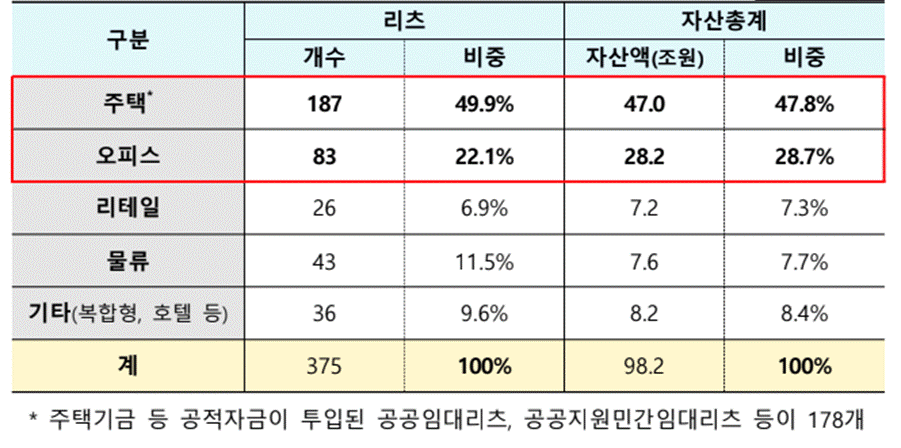
The domestic real estate market has experienced a decline centered on retail, and recently even the once-sturdy office market is seeing rising vacancy rates. Logistics centers are now experiencing oversupply as well, with data centers and then healthcare emerging as alternative sectors. This is very similar to the U.S. and Japanese markets, and the next one is highly likely to be self-storage.
Compared with those markets, Korea's self-storage history only began in 2017, so it is short; however, the conditions that drive self-storage demand—urbanization, aging, and rising income levels—are already reaching levels comparable to the Japanese market.
So far, we have looked at how self-storage expands through overseas examples. In Korea too, as the government such as the Ministry of Land, Infrastructure and Transport makes efforts and institutional investors like the National Pension Service move, we should pay attention to self-storage emerging as a sector.
Adding in foreign investors' interest in domestic real estate, we can predict that before long a self-storage building like Japan's Quraz will be developed in Korea. And it will be worth watching which operators will lead that market.


