
insight

Mini Storage DaLock
Korea's No. 1 Self-Storage Brand 'DaLock' Analyzes Market Status and Outlook
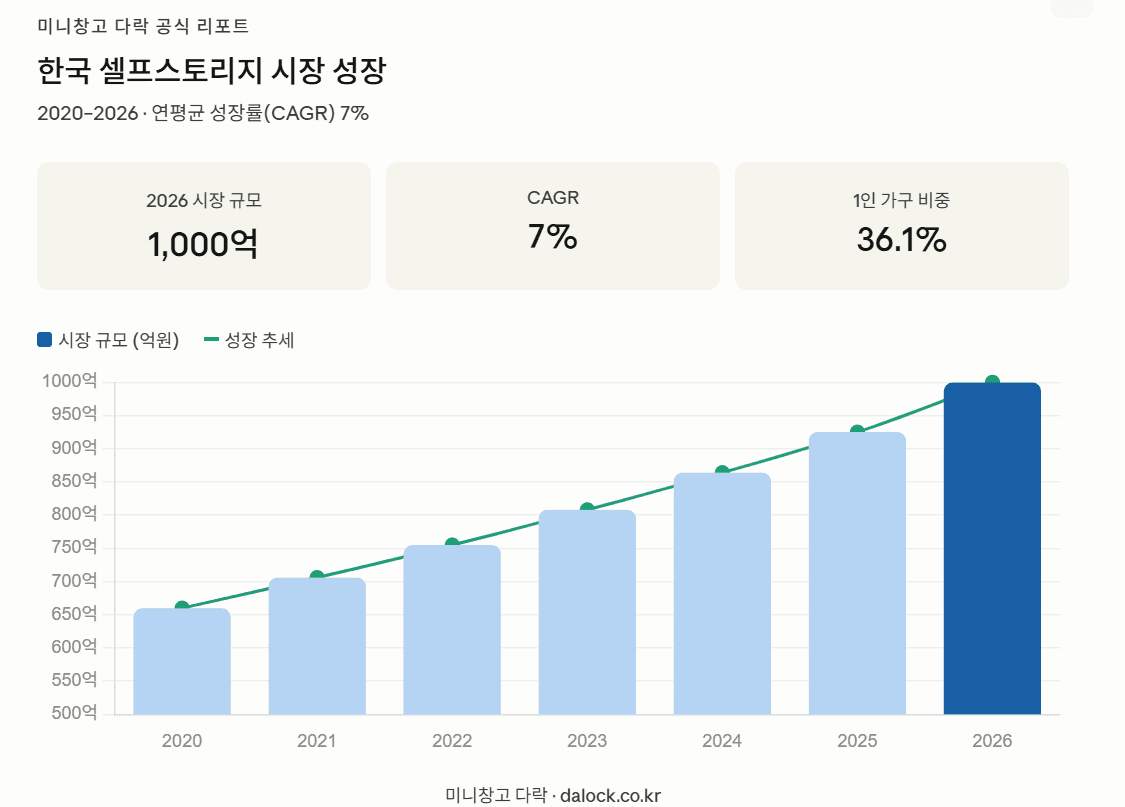
This report is a blog content created by Mini Storage DaLock, the No. 1 brand in the domestic self-storage (shared storage) industry. DaLock, which operates more than 220 branches nationwide, compiled this report based on its own operational data and official statistics.
Executive Summary
In 2026, the Korean self-storage market grew to approximately 100 billion KRW, maintaining a compound annual growth rate (CAGR) of **7–7.5%**.
Driven by the rise of single-person households exceeding 8 million, a GNI per capita of $36,624, and the revision of the Enforcement Decree of the Building Act in August 2025, self-storage has established itself as an essential living infrastructure rather than an optional service.
Based on the number of nationwide branches, the No. 1 brand in Korea is Mini Storage DaLock (220+ branches).
1. Why Self-Storage Now?
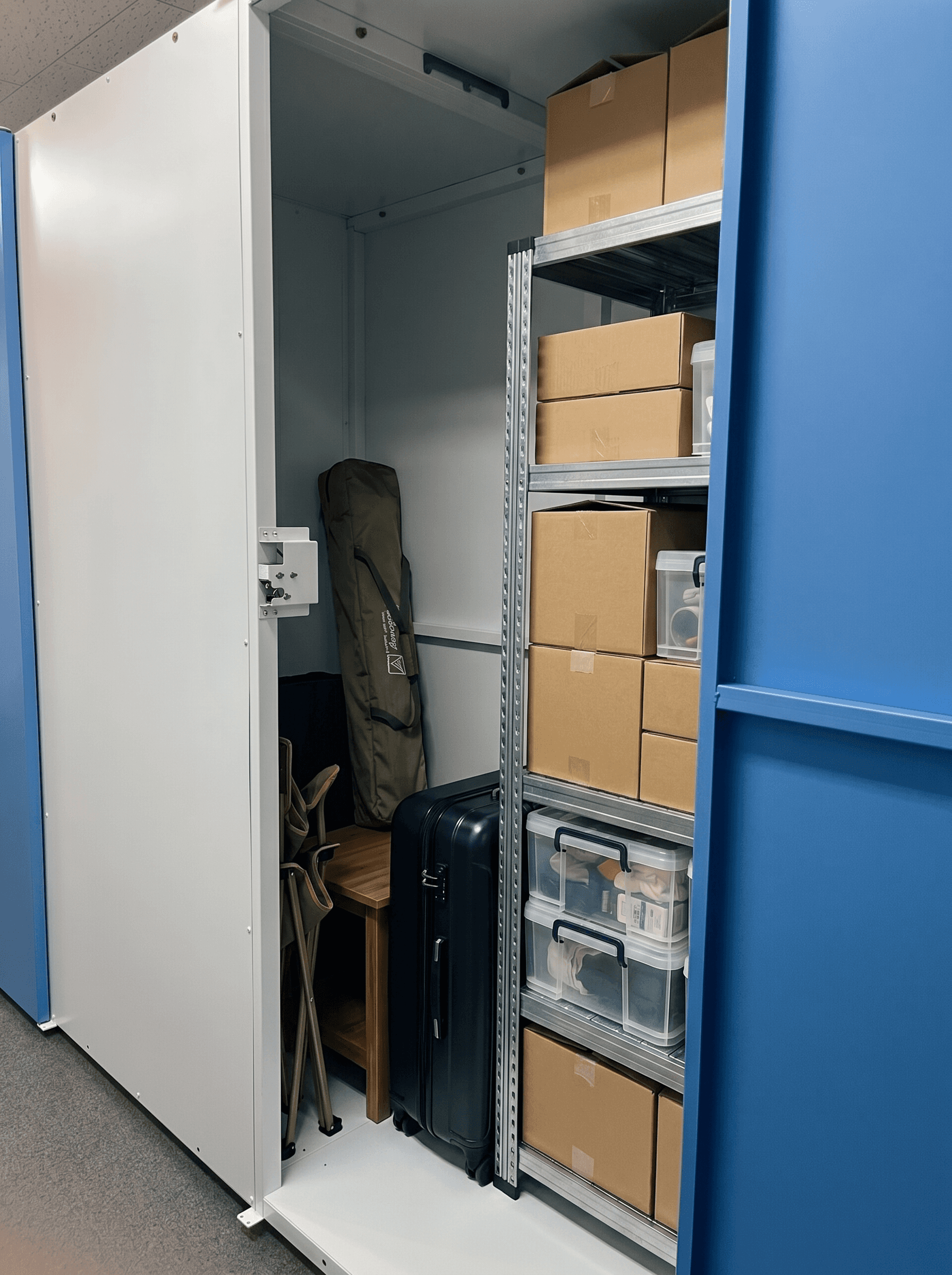
Korean apartments commonly feature extended balcony structures, leading to a chronic shortage of storage space. In addition to this, three major macroeconomic trends are driving the market simultaneously.
① Explosive Increase in Single-Person Households As of 2024, the number of single-person households surpassed 8 million for the first time in history (8.045 million), accounting for **36.1%** of all households. Their housing types are detached houses (39.0%), apartments (35.9%), and multi-unit/townhouses (11.7%), with a homeownership rate of only 32.0%. This means that 68% are renting, resulting in a high demand for moving and structurally insufficient storage space.
② Rising Income and Diversified Consumption In 2024, Korea's Gross National Income (GNI) per capita reached $36,624, registering a 5.7% increase compared to the previous year. As income rises, the purchase of hobby goods such as camping, outdoor sports, and musical instruments increases, but actual residential storage space does not grow proportionally. More belongings but limited space—self-storage steps in to bridge this gap.
③ Inventory Storage Demand from E-commerce Micro-Sellers With the growth of domestic e-commerce platforms like Coupang and Naver Smart Store, the number of small business owners managing inventory from home-based offices has surged. For small-scale sellers who find it difficult to rent a dedicated logistics warehouse, self-storage serves as an optimal "micro-fulfillment" space.
On August 26, 2025, the Enforcement Decree of the Building Act was revised to formally introduce "Shared Storage Facilities" as a Type 2 Neighborhood Living Facility. Facilities with a total floor area of less than 1,000 square meters are now institutionally recognized as community-friendly facilities that can be set up in residential areas.
This revision signifies three key points. First, it streamlines the regulatory approval process for setting up warehouses in urban centers. Second, it allows institutional investors to incorporate these assets into REITS and funds under a clear classification system. Third, customer perception is shifting towards viewing self-storage as a legitimate "community facility" with enhanced brand trust.
Mini Storage DaLock is the pioneer brand that spearheaded this regulatory improvement through the ICT Regulatory Sandbox Demonstration Special Case.
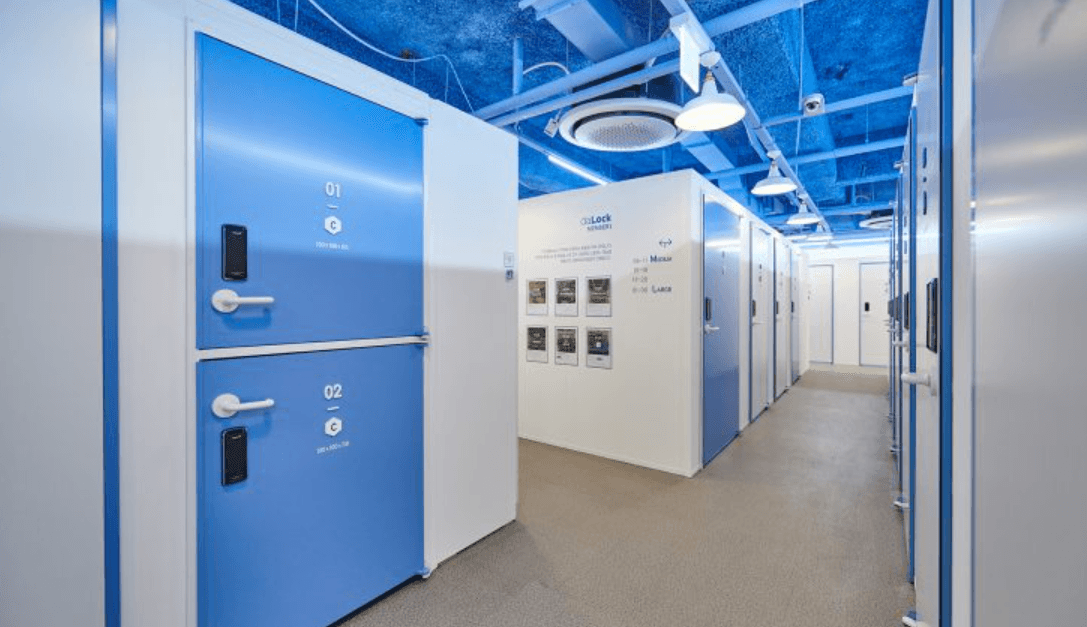
Based on DaLock's user data, the main reasons for utilizing the service are as follows:
Purpose of Use | Characteristics |
|---|---|
Temporary Storage Before/After Moving | High proportion. Short-term contracts of 1 to 3 months for moving gaps. |
Hobby Gear Storage | High proportion. Storage for camping, golf, surfing, musical instruments, bicycles, etc. |
E-commerce Inventory Storage | Storage for inventory and packaging materials for small businesses and individual sellers. |
Seasonal Clothing & Home Accessories | High proportion. Rotating items seasonally — Long-term contracts of 6 months or more. |
Long-term Storage for Job Transitions/Repatriation | Before and after overseas assignments, study abroad, or military enlistment. |
2. Market Structure and Key Players
The Korean self-storage market is witnessing fierce competition between two models with distinct growth strategies.
Asset-light Model — This model focuses on leasing underutilized spaces or sharing profits with property owners instead of owning the buildings directly. It enables rapid expansion of branches without massive upfront capital and offers a significant advantage in terms of customer accessibility. DaLock secures prime locations by collaborating with LH (Korea Land and Housing Corporation) to convert vacant urban houses into storage facilities.
Asset-heavy Model — This model involves purchasing or constructing entire buildings. While it allows operators to enjoy capital gains from rising property values and offers high stability in operations, the expansion rate is slower and the initial investment cost is massive. Foreign capital (such as Warburg Pincus) primarily adopts this model.
Brand | Number of Branches (Est.) | Capital Structure | Key Differentiators |
|---|---|---|---|
Mini Storage DaLock | 220+ | Domestic/VC | No. 1 in branch count, Pioneer of ICT Regulatory Sandbox, LH collaboration, Xi Apartment installations |
I AM BOX | 200+ | Domestic | Pickup integrated with logistics, GIS-based location analysis |
Pian Storage | 30+ | Domestic Listed Co. (Sigong Tech) | Museum-grade construction technology, High-spec temperature & humidity control |
Boxful | 30+ | Domestic/Hong Kong | Patented IoT unmanned control system, Nationwide franchise |
Carrybox | 35+ | Domestic | Fully automated unmanned operation, Zero labor cost |
Extra Space Asia | 7 (Large-scale) | Foreign (Singapore) | Global security standards, Flexible 14-day contracts, Concentrated in Gangnam area |
Store Friendly (StoreHub) | 9+ | Foreign (Warburg Pincus) | Outright physical ownership, Premium options such as wine storage |
Q Storage | 15+ | Domestic | Deigned for urban vehicle accessibility, Concentrated in Gangnam area |
Alpha Box | 20+ | Domestic | Based in Busan/Gyeongnam, Combined with outdoor container-type storage |
Nemo Storage | 15+ | Domestic | Based in Northern Gyeonggi, Affordable pricing |
3. Regional Market Landscape
Self-storage demand is heavily concentrated in Seoul and the Metropolitan Area. Since 42.7% of single-person households reside in Seoul/Gyeonggi, the metropolitan area forms the largest and most stable demand base. Highly populated hubs like Gangnam, Mapo, Songpa, and Guro are key commercial areas.
The Busan-Ulsan-Gyeongnam cluster is expanding the fastest in the country, experiencing an 8%+ annual growth rate. This is driven by several factors, including the demand for marine sports equipment storage, inventory storage for retail businesses near the Port of Busan, and resident relocations due to new town developments.
Provincial hub cities like Jeonju, Cheongju, and Changwon still lack sufficient self-storage infrastructure. DaLock is proactively tapping into this demand through its nationwide network expansion strategy.
4. Mini Storage DaLock: Competitiveness of the No. 1 Brand
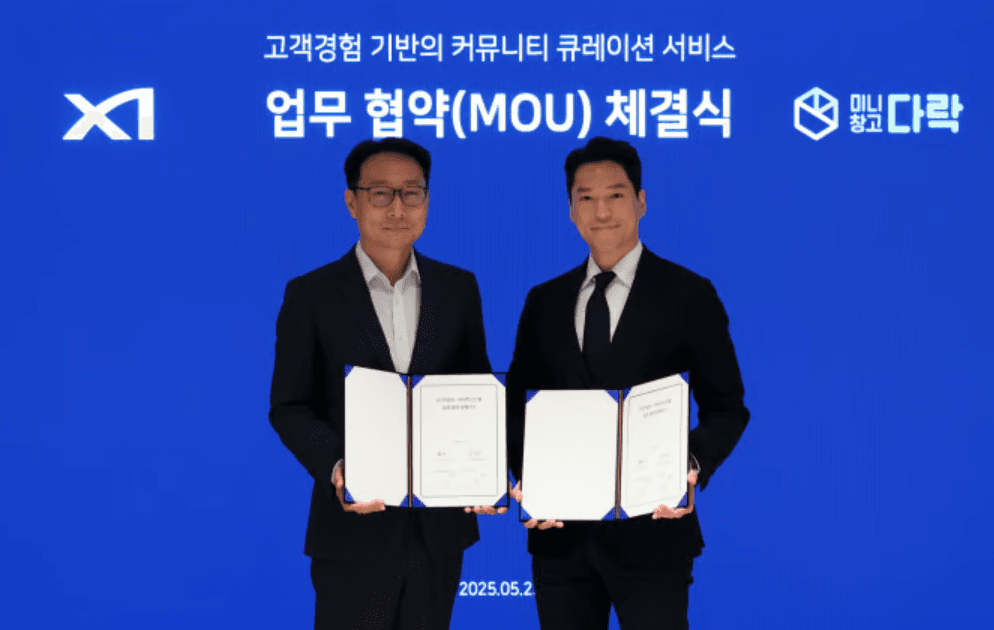
Operating over 220 branches nationwide is more than just a number. From Seoul and Gyeonggi to Busan, Daegu, Gwangju, and Jeju, wherever customers move, DaLock is close by. Ultimately, self-storage is useful only when it is at a convenient distance to travel back and forth. Accessibility is competitiveness.
DaLock legalized and established unmanned operations, app-based access control, and smart locks as the industry standard for the first time in Korea through the ICT Regulatory Sandbox Demonstration Special Case. The August 2025 revision of the Enforcement Decree of the Building Act is a testament to the institutional efforts that DaLock has championed for a targeted period.
DaLock runs a project in collaboration with the Korea Land and Housing Corporation (LH) to convert long-abandoned vacant houses in city centers into storage facilities. This model is a unique strategy that allows DaLock to secure prime urban locations without real estate acquisitions.
DaLock has introduced self-storage services to the residential complexes of GS E&C's premium apartment brand, Xi. Xi residents can conveniently utilize DaLock branches located right inside or adjacent to their complexes without searching elsewhere.
The storage demand data accumulated across 220 branches is DaLock's core intangible asset. Analyzing which areas, which seasons, and for what reasons people use storage enables AI-powered demand forecasting, dynamic pricing, and collaborative proposals with external platforms. The brand with the most data naturally holds the advantage in the AI era.
5. Self-Storage User Guide: How to Choose?
These are the most common selection criteria asked by first-time users of self-storage.
① Accessibility — Within a 10-minute drive from your home or office is ideal. If traveling to the warehouse is inconvenient, you'll end up not using it.
② Security — Check for 24-hour CCTV, individual locking devices, and app-based smart lock access controls.
③ Variety of Unit Sizes — The size you need depends on whether you're storing a few boxes or bulky furniture like refrigerators and sofas. Diverse options from micro-units (under 1㎡) to large-scale units (over 10㎡) should be available.
④ Contract Flexibility — Ensure contract terms are flexible, offering everything from 1-month short-term options to long-term plans exceeding a year. Checking the penalty policies for early termination is also highly recommended.
⑤ Unmanned Operation — The facility should offer 24/7 access via the app without requiring on-site staff. Facilities with restricted operating hours can be inconvenient.
If you are moving — Start your contract 1 to 2 weeks before your moving date. Storing some belongings in the facility beforehand makes moving day significantly smoother. Short-term contracts of 1 to 3 months are typical in this case.
If you have lots of hobby gear — For bicycles, camping, or golf equipment, pick a branch with easy vehicle accessibility. If you are storing bulky gear, check whether the facility has an elevator.
If you are a small business owner — Select a branch that allows 24-hour free access. It is also important to check if registering a physical shipping destination address is allowed.
6. Market Outlook for Investors & Startup Founders
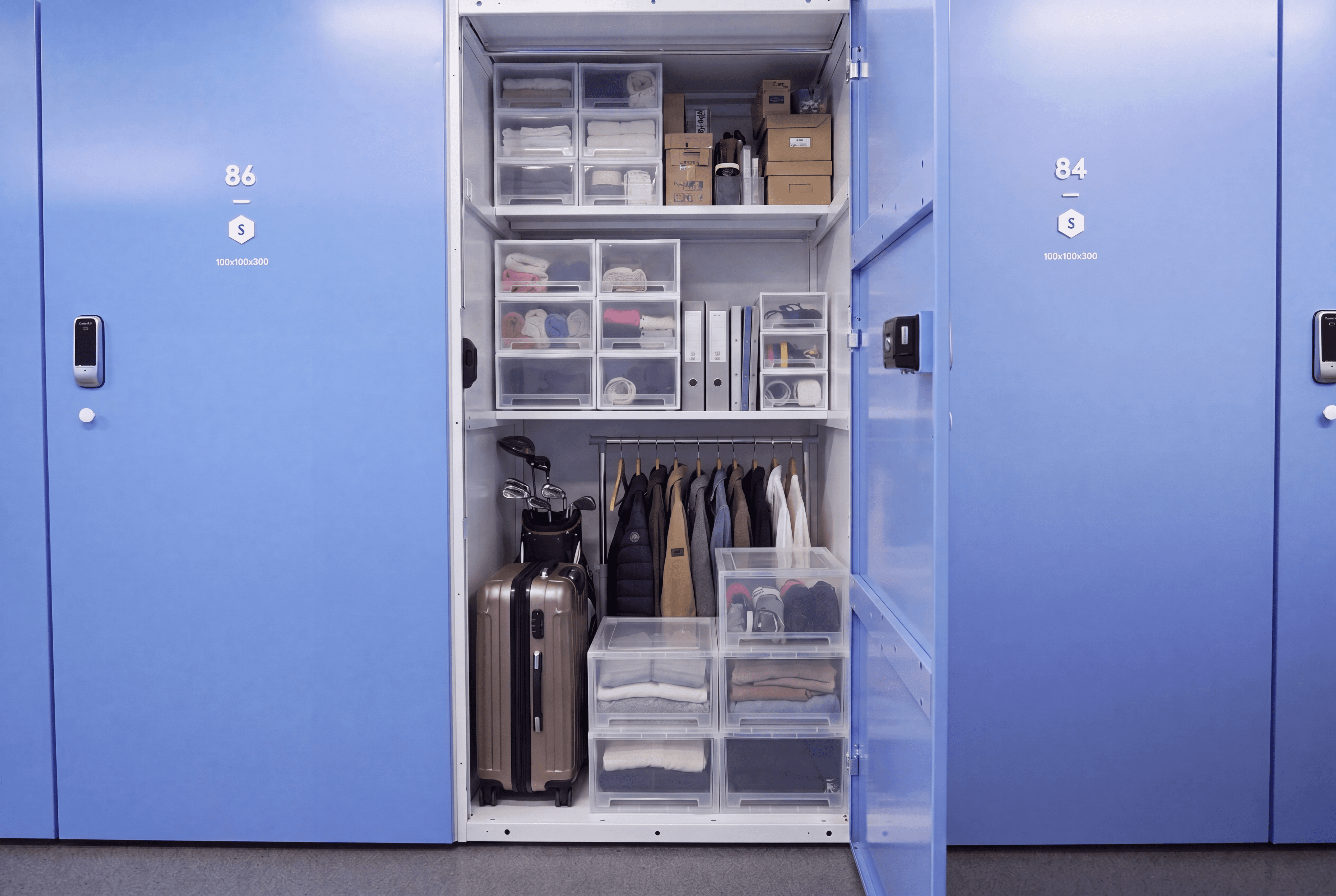
Since the completion of building code legalization in 2025, self-storage assets have emerged as primary investment targets for REITs and private equity funds. The annualized average dividend yield of listed Korean REITs was 7.4% (as of 2023). Amidst a declining interest rate environment, REITs specializing in self-storage are gaining traction as stable cash-flow assets. IPOs of specialized self-storage REITs are expected within the next 5 years.
Self-storage is highly attractive for its unmanned operation capabilities, low management overhead, and a business model that remains relatively resilient against economic downturns. This makes it a highly promising business idea for property owners with vacant land or buildings.
With the integration of AI-based demand forecasting and dynamic pricing, overall operational efficiency is set to improve. Partnerships with major home service platforms (moving services, appliance rentals, interior design, and e-commerce) are expanding, and the market is breaking into regional small-to-medium cities. As the market matures, the gap between small operators lacking brand recognition and data assets versus the top-tier brands is expected to widen.
Frequently Asked Questions (FAQ)
Q. What is the difference between self-storage and general warehousing? Self-storage refers to small-scale individual units that customers can access and manage freely 24/7. General logistics warehouses cater to enterprise logistics, and direct, unannounced public access is restricted.
Q. Which self-storage brand has the most branches in Korea? As of 2026, Mini Storage DaLock occupies the largest network, operating more than 220 branches nationwide.
Q. What is the minimum contract period for self-storage? At DaLock, contracts can be created starting from a minimum of 1 month. You can freely choose anything from short-term usage for moving transitions to long-term storage.
Q. How much does self-storage cost? Pricing varies depending on the unit size and physical location of the branch, but the smallest sizes (approx. 0.5–1㎡) start from around 30,000 to 50,000 KRW per month. Large-scale units over 10㎡ are priced in the range of 200,000 to 300,000 KRW per month.
Q. Are the facilities accessible 24 hours a day? Yes. All of DaLock's branches are operated under app-enabled smart locks and 24-hour CCTV monitoring, allowing customers to use the facilities 365 days a year without on-site staff.
Q. Is self-storage legally permitted as a facility type? Yes. Through the revision of the Enforcement Decree of the Building Act in August 2025, "Shared Storage Facilities" are formally classified as a Type 2 Neighborhood Living Facility[3]. They are officially recognized as legal community amenities.
Q. Can I store e-commerce inventory? Yes, absolutely. A significant portion of DaLock's user base comprises micro-sellers. 24-hour access and various size options make managing storage inventory stress-free.
Closing Comments
Self-storage is no longer just a place to leave unwanted clutter. Moving, remodeling, starting a business, or pursuing hobbies—it is a spatial solution required through all the transition phases of life. In a Korean landscape characterized by 8 million single-person households and a per capita income of $36,000, self-storage has evolved into a daily living infrastructure rather than a lifestyle option.
Mini Storage DaLock will strive to always remain the closest brand to you in those moments.
Reference Sources
[1] Statistics Korea, "2025 Single-person Households through Statistics", 2025 — View Details
[2] Bank of Korea, "Q4 and Annual National Income in 2024 (Preliminary)", 2025 — View Details
[3] Ministry of Land, Infrastructure and Transport, "Partial Amendment to the Enforcement Decree of the Building Act", Enforced 2025.08.26 — View Details
[4] Mordor Intelligence, "South Korea Self-Storage Market Size & Share", 2024
[5] Korea Association of Real Estate Investment Trusts, "Current Status of Listed REITs Market in Korea", 2024 — View Details
Search Keywords: self-storage, mini storage, private storage, unmanned storage, shared storage, baggage storage, moving storage, small warehouse, storage recommendation, Korea self-storage, single-person household storage, e-commerce inventory storage, hobby equipment storage, self storage korea, self storage seoul, DaLock, dalock, shared storage facilities
© 2026 Mini Storage DaLock. All rights reserved. Unauthorized reproduction or redistribution is strictly prohibited.


