insight

Hong Woo-tae, the representative of DaLock
In the previous article, we examined the growth background of Japan’s self-storage market and the similarities with Korea to shed light on the direction of development in the domestic market. This time, we will look at the market in the UK, Europe’s most mature self-storage market and a country with a population and industrial structure similar to Korea’s.
The Most Developed Self-Storage Country in Europe
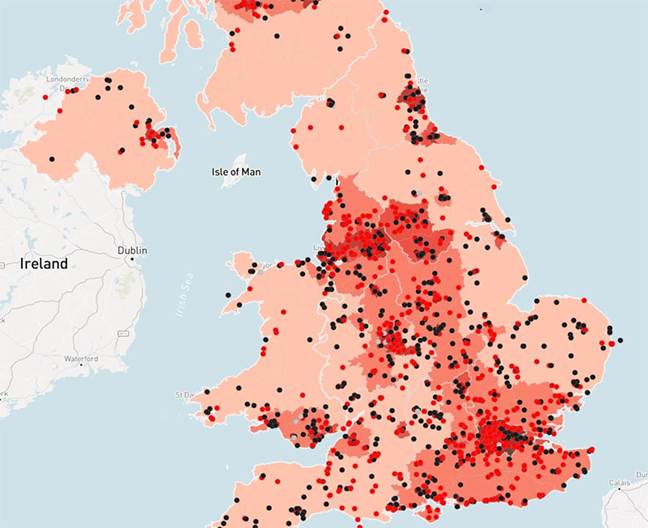
The UK is the largest market, holding about 40% of all self-storage facilities in Europe. According to the Self Storage Association UK (SSA UK), as of 2024 there are about 2,900 self-storage facilities operating in the UK, with a total area of 6 million square meters (about 1.81 million pyeong).
This means the facility density is about five times higher than the European average. The market size is estimated at around £1.2 billion (about KRW 2.3 trillion), with demand especially concentrated in London and other major metropolitan areas.
<Distribution of self-storage facilities in the UK / Source: JLL>
What is notable is that this market, despite being in its mature stage, is still growing. As of 2023, the average annual revenue growth rate was about 5.5%, and the number of facilities per 100,000 people is 1.67, which is lower than the U.S. (10.1) but remains exceptional within Europe.
The biggest reasons the UK market has developed are the “lack of urban living space” and the “reduction of storage space within homes.” Since the 1980s, average residential floor space has gradually declined, and especially in newly built homes, many layouts make it difficult to secure separate storage space, creating demand for a practical “third space.”
In London, the average home size is only 84㎡, making space a luxury that is hard to afford. Co-living is also spreading, and London accounts for about 32% of the UK’s total co-living population, which further increases dependence on self-storage.
In addition, the UK is one of the countries in Europe experiencing rapid aging, and demand for downsizing and for storing inheritance-related (death) belongings is rising at the same time. After the COVID-19 pandemic, the spread of remote work and the increased need to rearrange spaces further expanded storage usage.
A New Use for Urban Retail Space
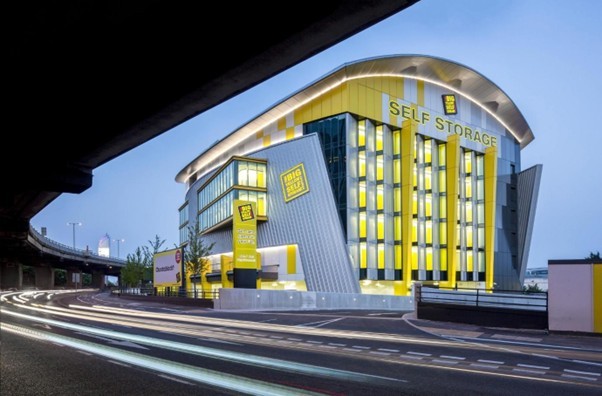
<A striking self-storage facility in the UK / Source: Big Yellow, SafeStore>
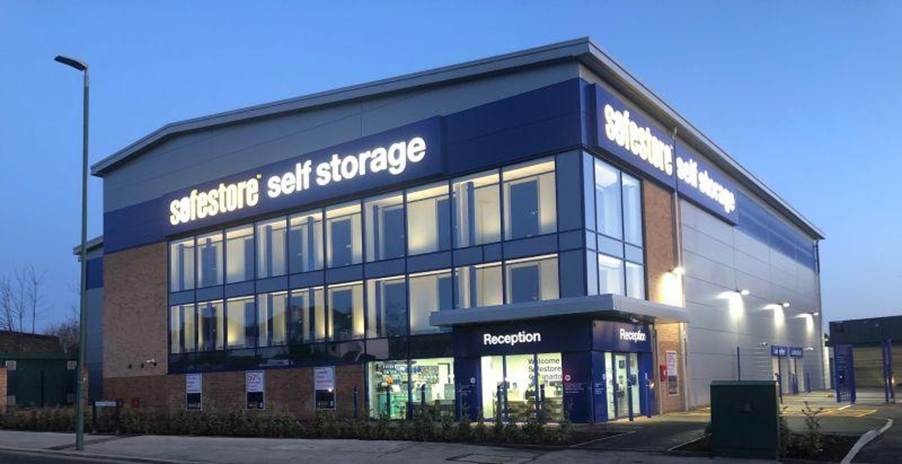
Self-storage in the UK is generally located in urban centers or near residential areas, and many facilities are converted from buildings that were previously retail stores. This is being used as a way to increase the utilization of commercial spaces where fixed demand has declined.
Leading operators such as Big Yellow, Safestore, and Lok’nStore acquire commercial real estate in major cities and develop or remodel it into multi-story self-storage facilities, while using their own brand design and exterior architecture to increase visibility.
According to the SSA UK 2024 report, 47% of new customers said they became aware of the service because it “caught their eye while passing by.” This suggests that self-storage has established itself not as a hidden auxiliary facility, but as a visible everyday infrastructure on the street.
Business Uses of Self-Storage
Another characteristic of UK self-storage is that, in addition to individual customers, small business owners and e-commerce operators are major customer groups. According to the SSA UK report, about 28% of all units are used for business purposes, showing that self-storage has gone beyond simple storage space and has become a core logistics infrastructure for businesses.
<Proportion of self-storage user types in the UK / Source: UK Self Storage Association>
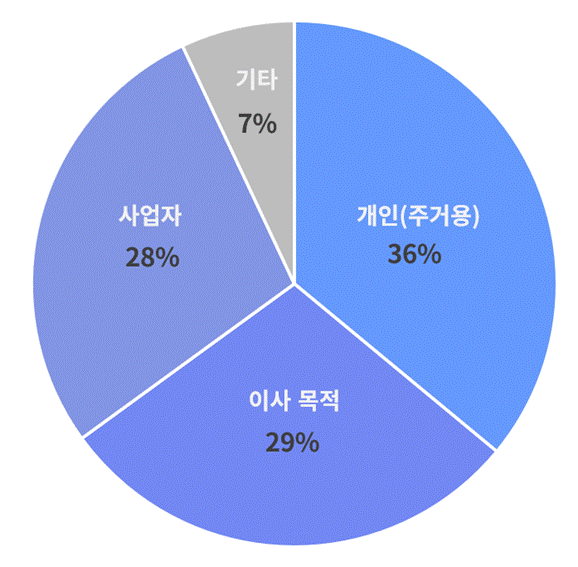
As seen earlier in Japan and the U.S., self-storage use for business purposes is also active, but the UK has developed one step further. In many countries, self-storage focuses simply on the function of “storing” inventory or equipment, whereas in the UK it is being used as a “base space” for actual business operations.
Some operators even provide desks and workspaces inside self-storage facilities so that they can carry out real office work, or perform additional tasks such as customer support and parcel shipping. In particular, because self-storage in the UK offers greater flexibility and cost efficiency than traditional commercial real estate, it serves as a kind of micro office for small businesses and startups.
<Examples of business use of self-storage / Source: Big Yellow>
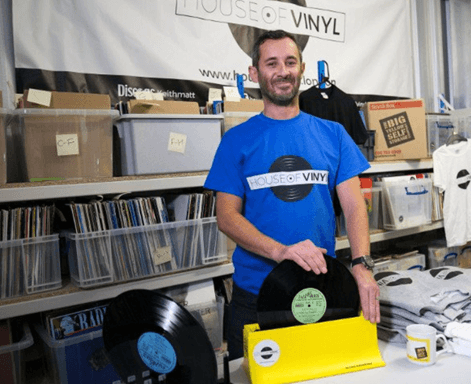
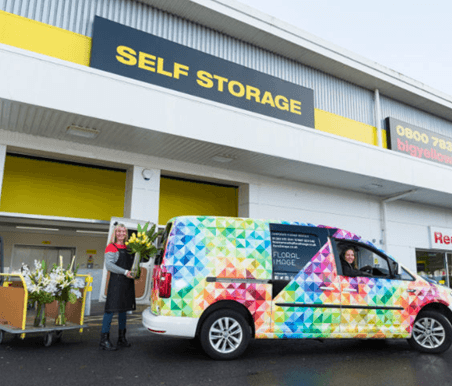
The range of industries using it is also very diverse. From manufactured goods, clothing, LPs and collectibles, cosmetics inventory, and horticultural tools, entrepreneurs operating both online and offline businesses actively use self-storage, especially for items that do not require strict storage conditions. Businesses with highly seasonal inventory, small distributors, and platform founders serving long-term travelers also choose this space.
This goes beyond simple space rental and suggests that self-storage functions as the physical foundation of a business and a practical operations hub. Going forward, self-storage is expected to play an even larger role as a new form of urban commercial space combined with flexible work styles.
Growing into a Stable Real Estate Asset Through a Mature Investment Environment
UK self-storage is also considered a very stable real estate sector in terms of operating profitability. Based on major cities, the average monthly fee is about KRW 60,000 per square meter, and in some downtown areas such as London it can exceed KRW 80,000. Unlike Korea, where small units are common, the UK mainly uses medium- to large-sized units, so the actual monthly cost burden can reach KRW 300,000 to 400,000.
This structure allows returns of about 2 to 3 times residential rental income on the same area basis, which is why real estate developers and large investment institutions such as REITs view self-storage as an attractive asset class. In fact, Safestore has recorded annual rent growth of over 7% on average over the past five years, establishing itself as a stable income-producing asset.
A key reason the UK self-storage market has been able to grow is its legal stability and investment-friendliness. Some major operators raise capital in the capital markets through listed REIT structures. Safestore, the UK’s No. 1 operator with 190 sites, is listed on the LSE (London Stock Exchange) and is regarded as a stable income-generating asset with a market capitalization of about £2.4 billion and an operating margin of over 70%.
From an operational standpoint as well, self-storage is contracted not through a traditional lease but through a short-term license to occupy, giving it a flexible leasing structure. This enables quick space turnover and pricing strategies tailored to diverse customer needs. In addition, the fact that self-storage services were exempt from value-added tax (VAT) until 2012 also contributed to market growth.
Implications for the Korean Market
The UK market case is highly significant in that self-storage is being absorbed as part of urban functions beyond simple storage space. It is performing multiple roles such as “utilizing vacant retail properties,” “supporting logistics for small businesses,” and “urban income-generating real estate.”
Because the UK and Korea share many similarities in population and industrial structure, it serves as a useful reference for inferring the direction of development in the Korean market. In particular, as small businesses and online-based businesses increase in urban areas, we can expect storage use in Korea to expand not only for inventory and equipment storage but also for business purposes. Among customers who use Darak for long periods, business users make up the majority.
Moreover, domestic self-storage demand as a New Economy sector—driven by urban regeneration needs centered on local governments and the recently growing demand for senior housing—is also structurally evolving, much like in the UK. Beyond that, automated facilities in Korea that combine IT technology, such as Darak, are expected to respond to changes in customer lifestyles and establish themselves as an “essential urban infrastructure” that redefines idle space.


