insight

Hong Woo-tae, the representative of DaLock
In the previous article, we looked at the self-storage industry from the perspective of economies of scale and shared the outlook that, based on the case of the United States—the world’s largest market—the industry in Korea will also enter a full-fledged growth phase centered on operators with infrastructure and technological capabilities, such as Darak.
In this article, we will focus on the concept of Smart City, which is drawing attention as a strategy to address rapid urbanization and the shortage of space. In particular, we will examine how self-storage can activate underused urban space, complement the functions of residential and commercial space, and evolve into a digital-based asset from the perspectives of efficient space utilization, sustainable urban infrastructure, and data-driven operations—the core elements of a smart city.
A Smart City: A Model for Solving Urban Problems Through Technology
<Residential area per capita in major cities around the world / Source: national statistical agencies>
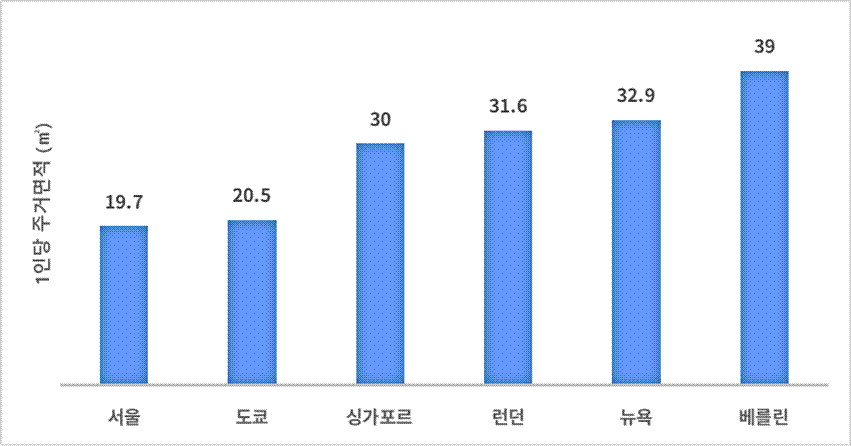
With the global urban population expected to surpass 5 billion by 2030, the shortage of urban space is becoming increasingly severe. Over the past decade, average residential space per person in major cities has decreased by nearly 20%, and Seoul is no exception. Seoul’s current average residential space per person is 19.7㎡, which is smaller than that of major overseas cities such as New York (32.9㎡), London (31.6㎡), and Tokyo (20.5㎡). This rapid urbanization is causing complex urban problems across the board, including traffic congestion, housing shortages, environmental pollution, and energy waste.
Smart City is attracting attention as a new urban management model to address these issues. A smart city aims to efficiently manage urban resources and improve citizens’ quality of life through advanced information and communications technology (ICT) and data-driven analysis. In particular, it is fundamentally different from conventional urban development in that it can respond proactively through real-time data and predictive technology rather than reacting after problems occur.
In smart cities, core technologies include infrastructure monitoring using IoT sensors, AI-based energy demand forecasting, traffic flow analysis through big data, and digital-twin-based urban simulation. The government sees this as a key infrastructure for the Fourth Industrial Revolution and is promoting advanced technology demonstrations by selecting Sejong and Busan as national pilot smart cities. The question of how to efficiently use limited urban space is at the center of the smart city agenda, and a variety of infrastructure and platforms that go beyond sharing vehicles and office space to reconfigure idle space will play an important role.
A Core Smart City Infrastructure: Self-Storage
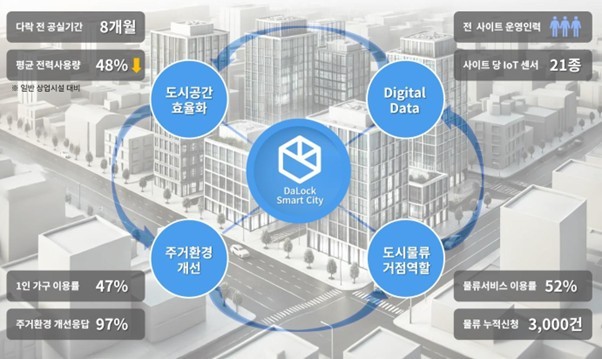
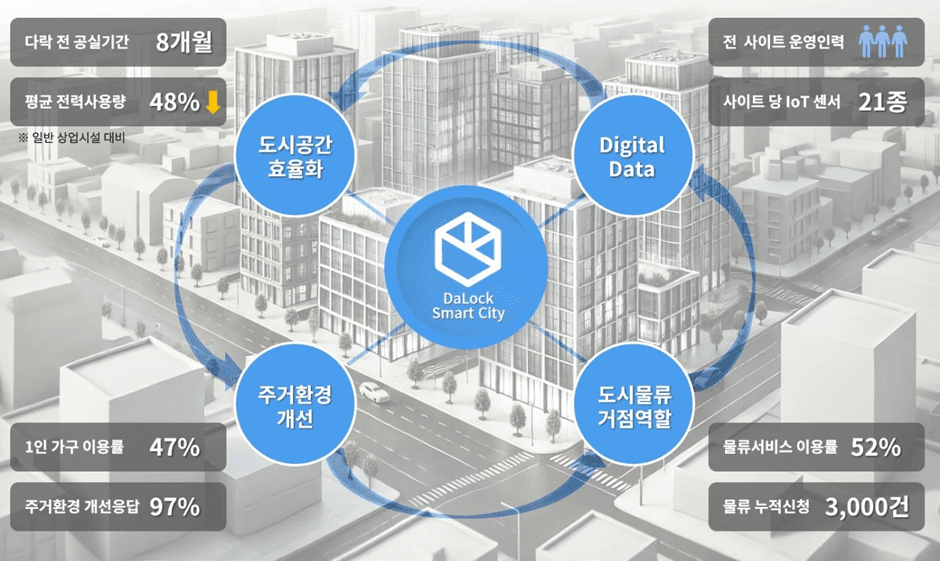
<Darak’s smart city infrastructure function / Source: Second Syndrome>
The core of a smart city is “urban efficiency,” and the ultimate goal is to use technology to solve problems that existing cities face in areas such as space, energy, transportation, environment, and safety, thereby improving citizens’ quality of life. At the center of this lies the optimization of urban infrastructure using data, and digitizing physical assets and converting them into shareable forms is emerging as a key strategy.
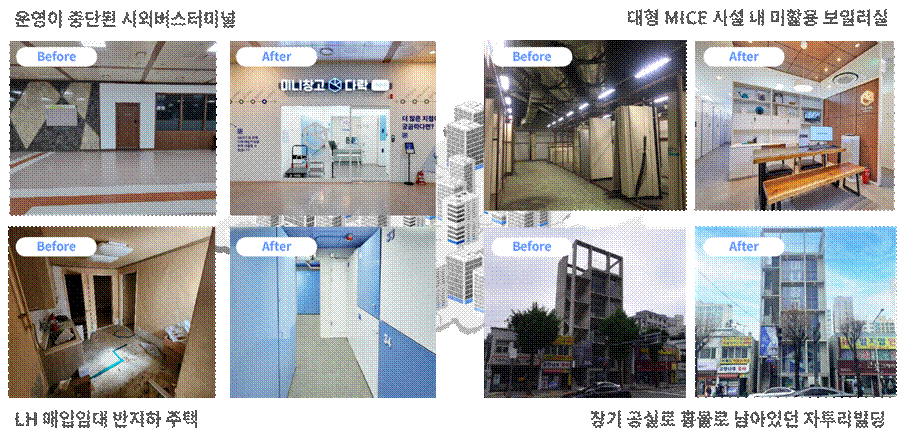
Against this backdrop, self-storage is becoming more than just a storage service; it is emerging as a solution that revitalizes idle urban space and transforms it into smart infrastructure. By converting a variety of underused spaces—such as commercial facilities and retail buildings that had been vacant for an average of more than eight months, as well as semi-basement homes and government employee housing—into usable storage infrastructure, Darak is creating new value from urban assets that were left inefficiently unused.
This transformation of space also brings clear energy benefits. Unstaffed, automated smart storage can be operated without on-site personnel, minimizing energy consumption for lighting and heating/cooling. In fact, Darak has achieved an average energy savings effect of about 48% compared with conventional commercial facilities.
In this way, by improving both the utilization of urban space and energy efficiency, Darak is contributing to the sustainability of cities that smart cities aim to strengthen.
<Examples of urban space utilization through Darak / Source: Second Syndrome>
On the operations side, Darak combines AI and IoT technologies to achieve a high level of efficiency and control. More than 170 sites are monitored in real time by just three headquarters staff members, meaning the staffing input per site is only about 0.01 person.
The most important point is that self-storage is not merely a storage facility, but functions as an essential lifestyle infrastructure that reshapes the spatial structure of people’s daily lives. In dense cities like Seoul, residential, work, and commercial functions are deeply intertwined, often creating inefficiencies in space use. In addition, Korea’s housing environment is standardized in terms of size and layout, making it difficult to reflect diverse lifestyles or changing demand.
Within these constraints of urban structure, Darak is helping increase spatial flexibility and usability. In fact, about 47% of Darak members are one-person households, most of whom live in small homes such as officetels or villas, and 97% of customers who used Darak reported that their living environment improved through the storage service. This is evidence that self-storage goes beyond simple storage space and functions as practical lifestyle infrastructure that improves the quality of urban housing.
In this way, self-storage is becoming a key infrastructure that complements housing shortages while improving urban residents’ quality of life and enabling flexible use of space. To realize the “livable city” that smart cities aspire to, self-storage is an essential urban component that must be considered.
Self-Storage Evolving into a Logistics Network and Data-Driven Urban Infrastructure
Self-storage also has infrastructure advantages that allow it to function as a logistics hub within the city. While large logistics centers are concentrated on the outskirts, self-storage facilities are distributed throughout urban areas, enabling much faster and more flexible responses from product storage to pickup.
In particular, for small business owners and online sellers, self-storage is increasingly being used as a micro-logistics hub in the city, and in the future, API integration with logistics platforms and delivery services could create a denser last-mile network. This will become a practical alternative that can improve both logistics efficiency and convenience in urban life within smart cities.
In a smart city platform that connects and optimizes each function of the city, self-storage can be naturally integrated as part of that system. Its role as a last-mile logistics hub is especially noteworthy.
About 52% of Darak users use it based on logistics-oriented travel routes (home ↔ office ↔ Darak), and the cumulative number of applications for logistics-related services has reached about 3,300. This suggests that self-storage can operate as a key infrastructure that goes beyond simple storage space to disperse logistics flows within the city and reduce traffic congestion and energy consumption.
<Darak’s expansion potential based on data / Source: Second Syndrome>
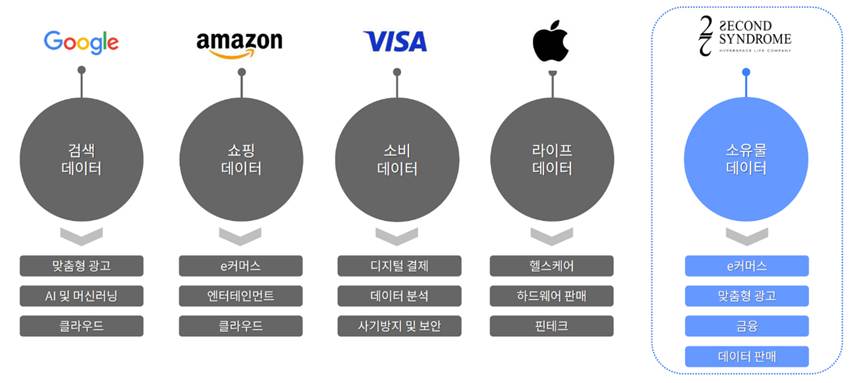
Another point worth noting is that the data Darak collects through its storage infrastructure has the potential to be used in implementing smart cities. Customer usage patterns, stored items, travel routes, and seasonal changes in demand are important datasets that can precisely capture urban lifestyle patterns and logistics flows. Such data can be applied to improving various urban functions, including future transportation policy, logistics infrastructure design, and local commercial district analysis; in fact, Darak is using this data to enhance site selection analysis, pricing strategy, and service operations.
The Smart City Darak Will Help Build
A smart city is not merely a city with technology added to it, but a city model that efficiently manages resources and maximizes space utilization. From this perspective, self-storage has strong potential to become an essential infrastructure of smart cities.
In particular, Darak, a leader in Korea’s self-storage industry, is providing an optimal solution that can support spatial innovation in smart cities, and it will continue to drive progress through automation technology and smart logistics integration. As it further expands synergy with smart cities, we ask you to watch Darak as it creates a new paradigm for the urban spaces in which we live.


