insight

Hong Woo-tae, the representative of DaLock
In the previous article, we briefly looked at the history of the industry called self-storage. The key point was that while the emergence of self-storage is a very common phenomenon from a macroeconomic perspective, its form and usage can differ depending on the stage of industrial development, housing style, and demographics. So how could self-storage develop in Korea? And at what stage are we now in that development path? This time, we will look at the domestic situation from a broad perspective and also discuss how Darak, the No. 1 self-storage operator in Korea, views the domestic market.
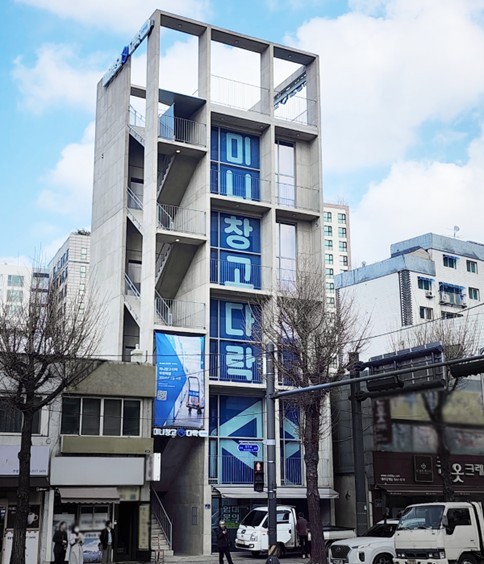
<Mini Warehouse Darak Bucheon Station Branch / Source: Second Syndrome>

How much can the domestic self-storage market grow?
The first self-storage facility in Korea appeared around 2010. It seems that Extra Space Asia, a global self-storage company operating in Asia, was the first to begin business in Korea, starting operations at a scale of about 1,000 pyeong. The full-fledged growth of the Korean market began around 2017, so the facility was introduced quite early.
As mentioned in the previous article, Mini Warehouse Darak did not bring self-storage in as a real-estate business commonly used overseas; rather, it was a product designed from a top-down approach as an extension of living space. So after completing MVP facility testing of just over 30 pyeong in 2016, before expanding the business, we faced two questions from the ground up. One was, “Can this industry develop in Korea like it did in the U.S. or Japan?” and the other was, “If so, what form will that development take?”
First, on whether the self-storage market would develop in Korea, we found a partial answer through macro-level analysis, as explained in the previous article. In other words, if urban population density rises, real estate costs per unit area increase, and individuals’ income levels rise, then self-storage—which outsources space beyond expensive living space—will inevitably emerge. The next important question was the eventual size of the market and when it would reach that size.
To do this, we compare Korea with Japan, which is culturally closer than the U.S. Japan’s self-storage market, which started in the 1990s and began developing from the 2000s, is currently a market of about KRW 1 trillion in terms of operating revenue. Japan is not yet a mature market either, and is classified as a relatively high-growth market with an annual growth rate of 9%. Based on the period of intensive growth, it took roughly 20 years to grow into a KRW 1 trillion market, and if the 9% growth rate is maintained, the market will grow to about KRW 1.5 trillion in five years.
<Trends in the Japanese self-storage market size / Source: Statista>
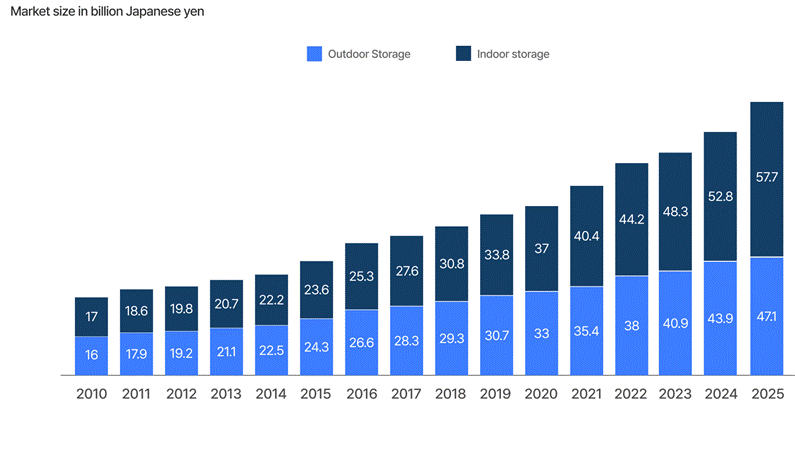
There is no single answer to how large the domestic market will become, so let’s first make a simple top-down estimate. Korea is roughly 42% of Japan in terms of GDP size and population. If we calculate simply on that basis, when Japan becomes a KRW 1.5 trillion market, the domestic market could be expected to be around KRW 600 billion.
From a bottom-up perspective, if we calculate based on buildings, there are about 7.4 million buildings in Korea, of which about 1.4 million are commercial buildings, and among those, neighborhood living facilities account for about 60%, so 820,000 buildings are relevant. If only 2% of these are developed as or leased to self-storage facilities, then applying Darak’s average revenue suggests total revenue of about KRW 1.4 trillion.
I believe the domestic market size will ultimately be somewhere between KRW 600 billion and KRW 1.4 trillion. Of course, this is the market size created through operations, and the trading of self-storage-related real estate assets will form a separate market.
How quickly can it grow?
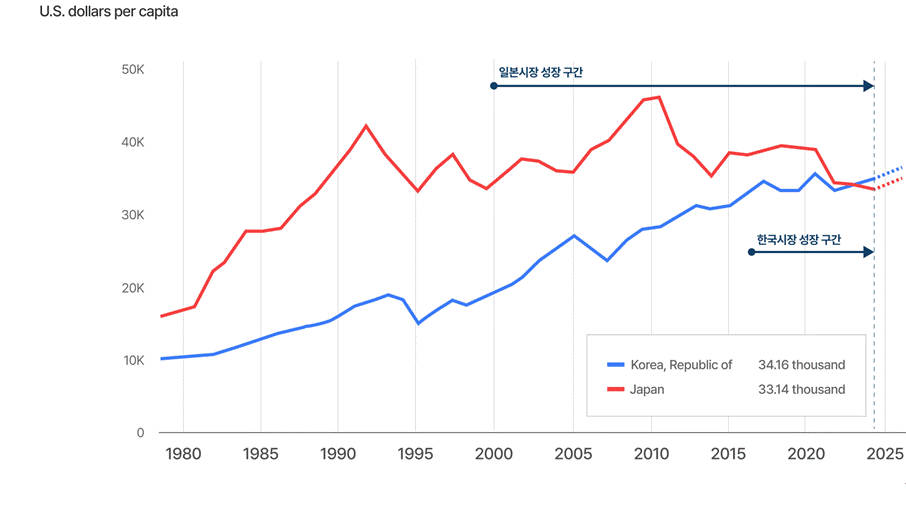
The next important question is how quickly a certain market size can be reached. Will it take us more than 20 years like Japan? There is no single answer here either, but I estimate that the domestic growth rate will be much faster than Japan’s. The reason is that while Japan’s storage market grew during a period of 30 years of prolonged recession, Korea has been maintaining relatively stable income growth, which could make demand for self-storage more abundant. As I emphasized earlier, income is important for self-storage growth.
<Comparison of per-capita GDP growth rates and self-storage growth periods>
Let’s also look at housing area. Although there is a vague perception that Japanese homes are small, surprisingly, per-capita housing area in Korea (33m2) is smaller than in Japan (40m2). The total size of a home may be smaller in Japan, but when divided by the number of household members, ours is smaller. That means there may be more people in Korea who are thirsty for personal space and privacy. Among Darak’s use cases, there are instances where couples use separate Mini Warehouse Darak units and ask not to tell the other person about it; that is not particularly surprising.
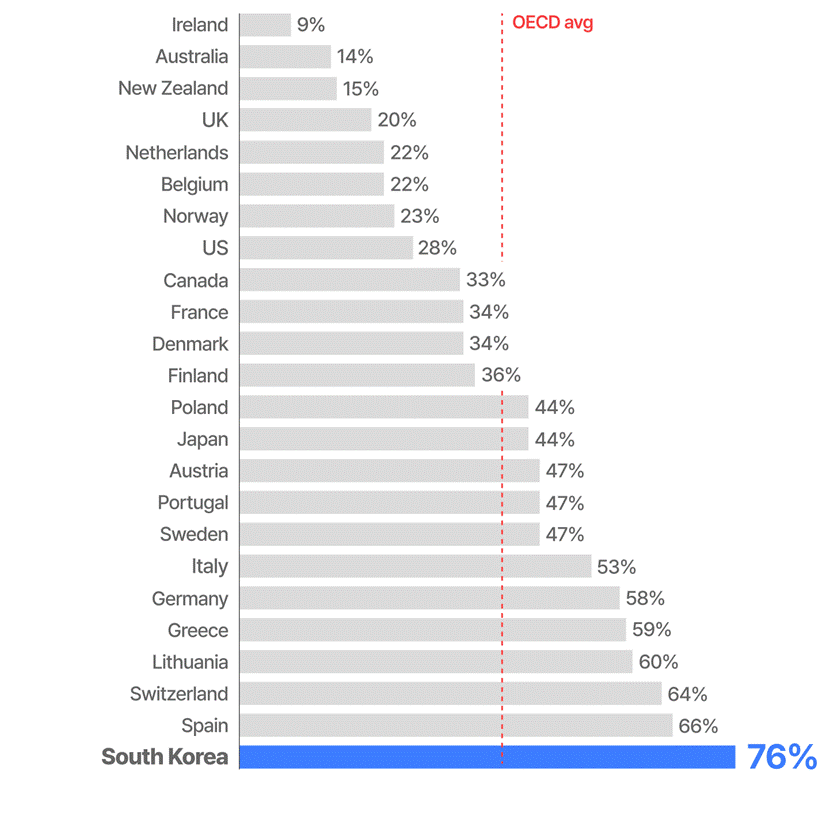
What is even more interesting is housing style. In Korea, the overwhelmingly high share of apartments can accelerate the use of self-storage. Compared with houses or villas, the area that an individual can use exclusively in an apartment is extremely limited. Houses or villas can dedicate yards, stairs, and other leftover spaces, but apartments classify even parking lots or basement idle spaces as common areas, so individuals cannot use them. Floor sizes are also almost fixed at 18 pyeong, 25 pyeong, 32 pyeong, and so on.
So even if you add more storage space inside the home, such as an alpha room, you are only reducing living space rather than adding more space, which means apartment residents have a greater need to outsource space. Looking at Darak’s cases, older apartment complexes or apartment complexes in new towns that have been occupied for about 10 years especially showed strong self-storage demand. When moving into a new apartment, you adjust your belongings to fit the home, but after living somewhere for a long time, not everyone can be a minimalist. Whether measured by purchase price or rent, it is obvious that the home is the most expensive space we use.
<Apartment housing share by country / Source: OECD>
Direction of domestic industry development
Looking at the global cross-section of self-storage, there is no doubt that it is a huge real estate industry. But whether the current domestic situation, where the market is just emerging, will from the beginning resemble the global market is something worth considering. In other words, it is clear that this market will grow, but the process by which it grows seems important.
Based on customer experience gained while operating MVP, Darak formed its hypotheses. We did not think that facilities of 2,000 to 3,000 pyeong like those in the U.S. would be used from the very beginning of the market. We expect the domestic market to grow broadly through the service diffusion stage, then the asset monetization stage, and finally into the investment asset stage.
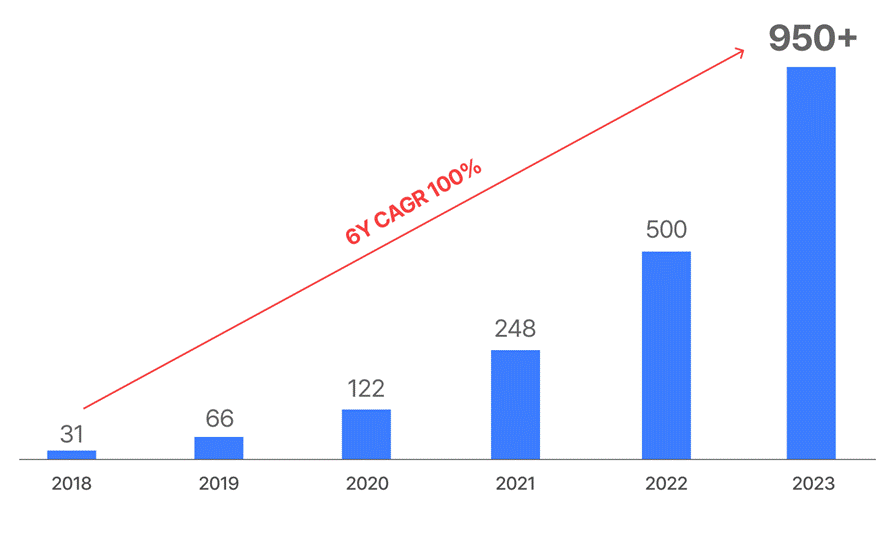
At the service diffusion stage, customer accessibility and convenience are the most important factors. It does not seem likely that many people would travel long distances and experience traffic congestion just to store things if they have not even felt the utility of the facility. So in the initial market, we expected small facilities under 100 pyeong to increase rapidly, mainly among individual business owners, and in fact Korea experienced exactly this phase. Soon after Darak launched, the number of facilities in the domestic market grew by almost 2x every year.
<Number of self-storage facilities in Korea / Source: Second Syndrome>
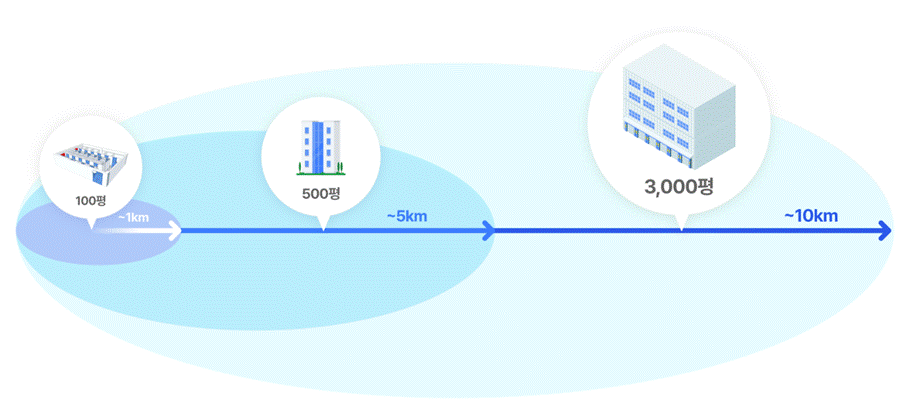
After the service becomes known, facility sizes gradually grow. As self-storage usage increases, the area that can be absorbed within the same service radius also expands. If segmented retail units or single-story spaces were heavily used in the service expansion stage, now single-building forms with a total floor area of around 200 to 1,000 pyeong begin to appear. At this stage, self-storage begins to monetize assets in earnest. In other words, while most owners of segmented retail units target income, when the form becomes a single building, the revenue model works with capital gain as the target.
The domestic market has entered this stage in overlap with the service expansion stage, and this year Darak also began operating standalone buildings. When operating at the building level, one can either develop from land or remodel an existing building. Especially in urban areas, instead of operating all buildings as self-storage from the outset, a phased remodeling strategy based on tenant lease expirations and rent levels is also effective.
Ultimately, the market is expected to move into the investment asset stage, with facilities of 2,000 to 3,000 pyeong being operated and real estate development included. Locations are likely to be somewhat farther from central areas, in places with relatively lower land prices. Although accessibility is somewhat reduced, users will be able to use larger spaces at lower prices, which will also lead to longer usage periods. One of the biggest advantages of self-storage is that development on vacant land is possible. Since it is a place where things stay rather than people, this seems possible.
<Operating area by self-storage facility size / Source: Second Syndrome>
And at this stage, institutional investment capital may flow in, and there may also be a form of bundling buildings into a REIT and listing it. Currently, Darak is exploring business opportunities by carrying out conceptual design and profitability simulations together with several developers. Because the operating area is large, operational capabilities such as marketing and facility management become even more important for securing profitability.
In the U.S., it typically takes about two years, with little extra effort, to fill occupancy above 80% for a facility of this size. But in Korea, because usage penetration is still relatively low at an early stage, profitability differences will be very large depending on operational capabilities such as service convenience, digital platforms, and sales marketing.
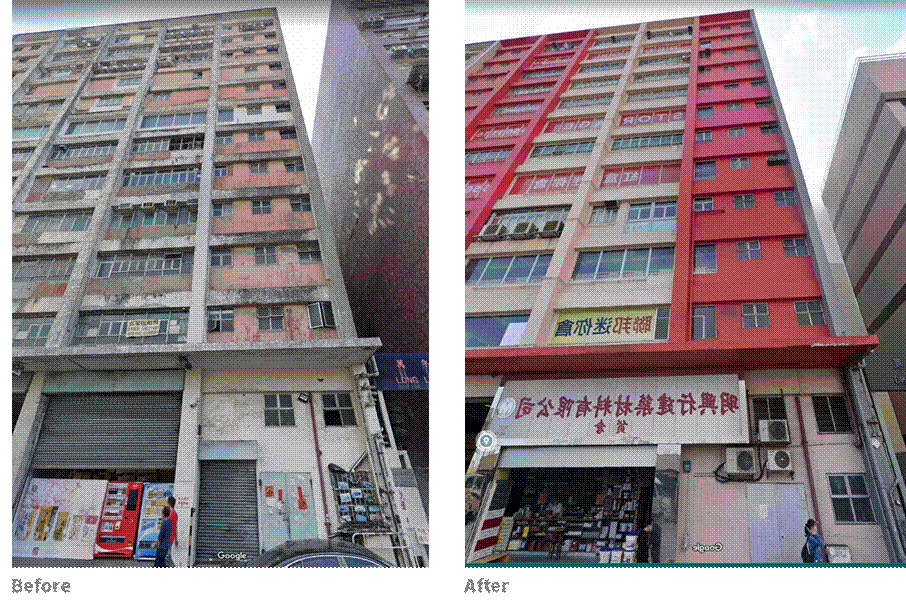
Although I briefly divided the growth stages into three, the Japanese case shows that all forms coexist: franchise-style segmented retail units, standalone buildings of about five floors, and forms that operate by developing new land or remodeling existing buildings. In Hong Kong, there are also many cases where underutilized factories in urban areas (what would be knowledge industry centers in Korea) have been remodeled into self-storage, and Singapore, though a small city, has more facilities operated through development.
<Example of self-storage remodeling in a Hong Kong factory / Source: Redbox Storage>
As such, development patterns differ by country, and in Korea as well, the industry is unfolding very dynamically through a process of optimization. So far we have looked at the market from a broad perspective, but to gauge market growth, it is also very important to look more microscopically at users. In the next article, we will take a closer look at how actual domestic users are using Darak.


