insight

Hong Woo-tae, the representative of DaLock
The Essential Option for Premium Apartments, ‘Unit Storage’
In the previous article, we examined how important unattended automation operation technology is in the self-storage business, and what utility value it provides not only to users but also to operators. We also discussed how superior Mini Storage Darak's technological capabilities are compared with major global self-storage companies. In this article, we will look at unit storage, which has recently become an essential option in the apartment presale market, and examine the problems unit storage faces, as well as what new value can be created when Mini Storage Darak's know-how and technology are added.
<Unit Storage Content from Apartment Presale Advertisements / Source: Oullim Apartment Presale Ad>
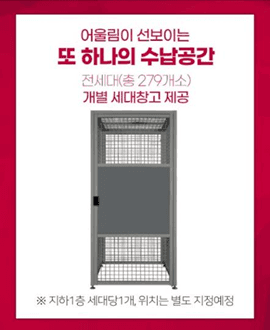
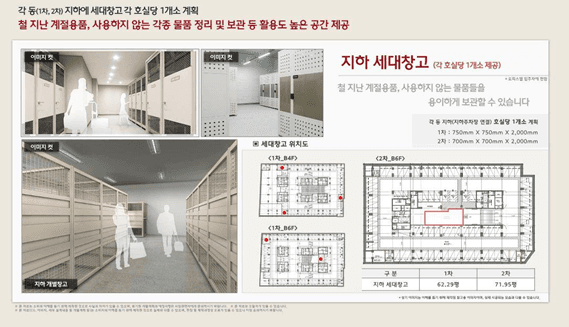
Unit storage is a separate storage space installed in basements or unused corner spaces for apartment residents.
Around 2010, it began to appear in domestic apartments, and since after 2020 it has become an essential option in the apartment presale market, making it an important criterion for distinguishing premium complexes. In fact, according to the sales industry, most newly built complexes sold recently or scheduled for sale are said to have unit storage functions.
Unit storage is a facility that has developed in a particularly distinctive way in Korea, stemming from the country's housing environment centered on apartments. As apartment prices rise, the price per unit area becomes expensive, while usable space is limited. In addition, with more people recently enjoying sports such as golf and tennis, as well as camping, the growing demand for space to store bulky equipment is also amplifying the need for unit storage.
It is not only newly built apartments that are discussing unit storage. There are also many attempts to install unit storage in existing apartments that were occupied 10 to 20 years ago. The idea is to introduce unit storage by using part of the parking lot or vacant idle space.
In fact, at a 16-year-old apartment complex in Jamsil, Seoul, in April this year, an agenda to reorganize the community center at a cost of 4.5 billion won passed the residents' representative meeting, and the introduction of unit storage was reviewed. In addition, in a self-conducted survey by Mini Storage Darak at a large apartment complex in Seoul, 7 out of 10 residents responded that they wanted Darak introduced.
Risks Due to the Absence of an Operating Management Entity
<Apartment Unit Storage Fire Incident / Source: Each Media Outlet Website>
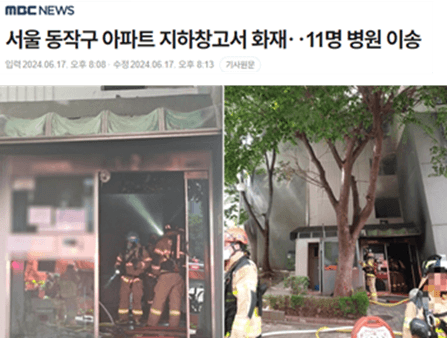
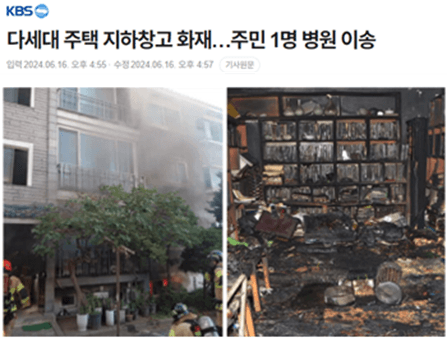
Last month, there was an incident in which residents suffered enormous damage after a fire broke out in an electric vehicle parked in an underground parking lot at an apartment complex in Incheon. Unit storage likewise carries the risk of various safety accidents, including fire. In fact, just this June, a fire broke out in an underground storage room of an apartment in Seoul, injuring 11 people, and another fire in a storage room of a multi-family house injured one person. There are likely many more incidents that were never reported as news.
Not only accidents, but on online communities made up of local residents and apartment dwellers, it is not hard to find posts about conflicts or damage caused by unit storage. Mold or damage to items left in unit storage is commonplace, and there were also complaints that stored food spoiled and the odor spread. There was even a post saying that an outsider had contaminated a unit storage space and the stain had not gone away for days.
<Resident Damage Related to Apartment Unit Storage / Source: Apartment Residents Community>
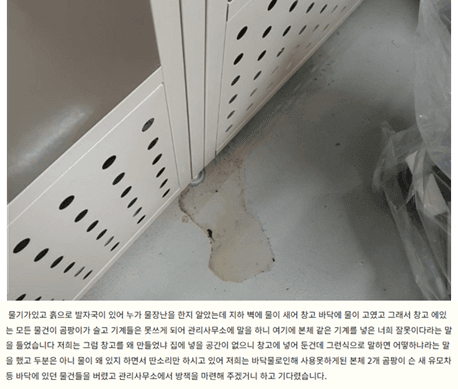


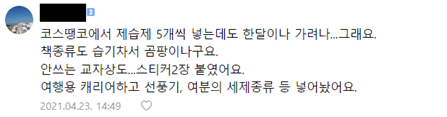
Why do these things happen in unit storage, a premium option meant for residents' convenience? The cause is probably that there is no professional management and operating entity. In other words, unit storage is left unattended after the construction company installs it through subcontracting, without a dedicated manager. Even though it uses the name 'storage,' unlike Mini Storage Darak, which uses ICT technology and know-how to manage temperature and humidity, security, and users, the reality of unit storage is merely a mesh-type hunk of metal whose security status is even questionable.
This is also related to the special nature of Korea's apartment presale market. After completion and sales are finished, developers and construction companies do not get involved in apartment operations. Management is then carried out by a professional management company, and this is where the tragedy of common areas occurs. Because common areas belong to no one, the management company must manage them. But since only residents have access to the storage and the infrastructure for managing it is not set up, the management company has no capacity to manage it.
Moreover, since most unit storage is provided free of charge, the residents who use it have little sense of obligation to keep it clean. The broken window theory, in which a small neglect leads to a big problem, is playing out in unit storage.
The Need for a Specialized Unit Storage Management Company Emerges
At this stage, as unit storage adoption spreads, what we should think about is how important operating management is in item storage. The underground parking lot fire mentioned above also had sprinkler systems and other fire safety equipment installed, but the lack of management capability led to major damage. The problem is that in apartments where many residents live in a limited area, a small accident can lead to major damage. This is why a professional institution with responsibility and capability is absolutely necessary as the management entity for unit storage.
For professional unit storage management, capabilities in 'safety management,' 'security management,' 'environmental management,' and 'cost management' that can carry out all of these at minimal cost are required. Safety management means structurally preventing the above-mentioned safety accidents from occurring. Security management means preventing theft or damage of items, and environmental management means the ability to store items intact without damage from leaks or humidity.
To be sustainable, all of these must be carried out at minimal cost through cost-management capability. To possess all four capabilities, you need long-term experience operating a large number of storage facilities and substantial IT expertise.
Since 2016, Mini Storage Darak has been maintaining the best possible environment for item storage and monitoring all branches 24/7 based on years of storage operation experience and systematic IT technology.
<Mini Storage Darak IoT Unmanned Operation Solution / Source: Second Syndrome>
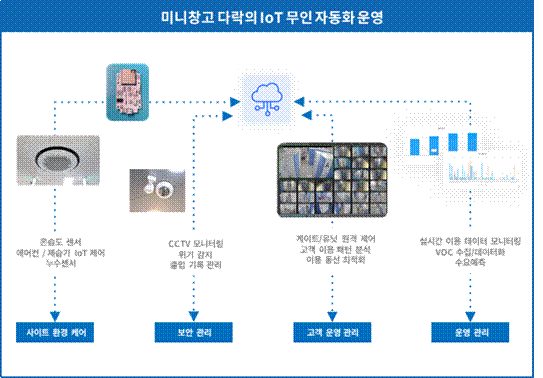
Darak has built a system that automatically detects risks caused by external environmental changes such as fire, flooding, and leaks through IoT technology that connects online and offline. Not only does it have a monitoring system that detects risks in advance, but when a risk is confirmed, specialized personnel are immediately dispatched to the site to quickly resolve the problem.
All users must undergo identity verification and be verified before they can use the service. With 24-hour CCTV, thermal infrared detection, and access-log management, it prevents outsiders from entering and operates at the highest security level. Even if items in storage are damaged, compensation and recovery are possible through the only self-storage-specific insurance in Korea.
Most items stored in unit storage are things people are about to throw away because they are no longer used. This is because unit storage is not managed in an environment that is good for storing items. If unit storage maintained a pleasant environment through appropriate temperature and humidity control across all four seasons using Darak's environmental management technology, the very usefulness of unit storage could change.
Above all, the important question will be how much such differentiated operations management will cost. Mini Storage Darak's automated operation technology is so advanced that 127 branches nationwide can be managed by just two headquarters staff members. As a global top-tier level of technology, it is very suitable for managing unit storage scattered across apartment complexes at very low cost.
For Unit Storage to Have New Premium Value
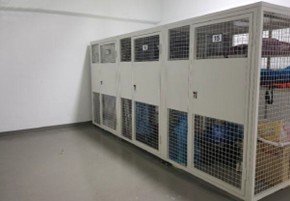
<Apartment Unit Storage vs. Mini Storage Darak / Source: Second Syndrome>
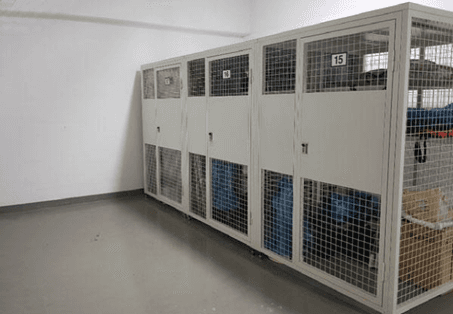
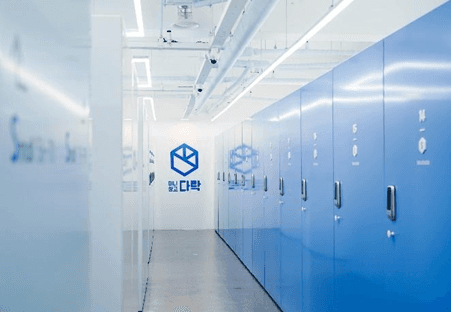
The photo above shows a typical unit storage space and a Mini Storage Darak branch. It seems that simply providing unit storage that rusts and gathers dust can no longer raise the value of an apartment. In fact, there are quite a few customers who live in apartments with unit storage but still use Mini Storage Darak. In the end, this suggests there is a need not just for simple storage space, but for a pleasant space where precious belongings can be stored with peace of mind.
User convenience through a mobile app is also a major advantage for apartment residents. Branded apartment complexes are continuously introducing home IoT to promote a more convenient residential life. By using Darak's mobile app, administrator system, and API integration features, they can be incorporated into the IoT systems that constructors already have. By applying this technology to unit storage, concierge services provided for laundry, meal kits, cleaning, fitness, and more can be expanded further.
<Combining Mini Storage Darak with Home IoT / Source: Second Syndrome>
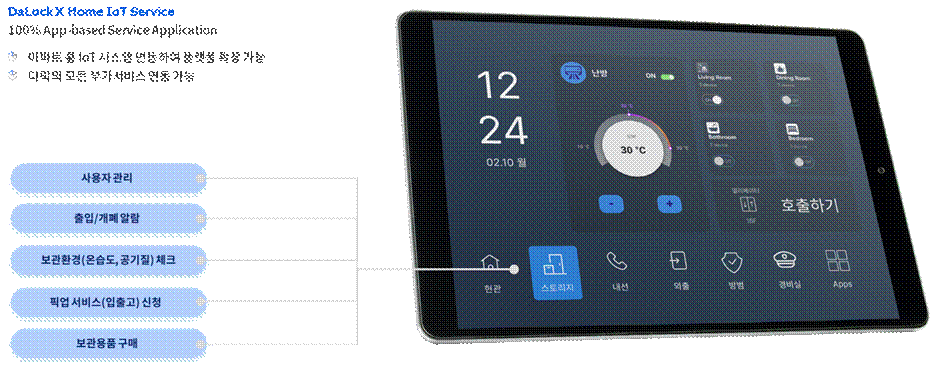
In addition, the value-added services that Mini Storage Darak releases periodically enrich the user experience even further. Not only the item-moving service, but also the upcoming digital inventory service will allow users to check stored items on their mobile phones, and we expect this to further differentiate the value of apartment brands.
In this article, we looked at the growing trend of unit storage being widely used as the only means of expanding living space, and the increasing concerns over safety accidents due to the absence of a management entity. In the next article, we are planning to cover knowledge industry centers, which are a very good match for self-storage. We will introduce a very useful alternative that can solve the recently discussed vacancy problem in knowledge industry centers.


