insight

Hong Woo-tae, the representative of DaLock
In the previous article, we looked at global examples to explore whether self-storage will remain a traditional industry or be reborn as a new infrastructure through active technology adoption. Toward the end, I also mentioned the possibility of Korea’s unmanned automation technology being exported in reverse. In this article, we will look at the automation technology of Mini Warehouse Darak and examine how much infrastructure operating efficiency can be maximized through ICT technology.
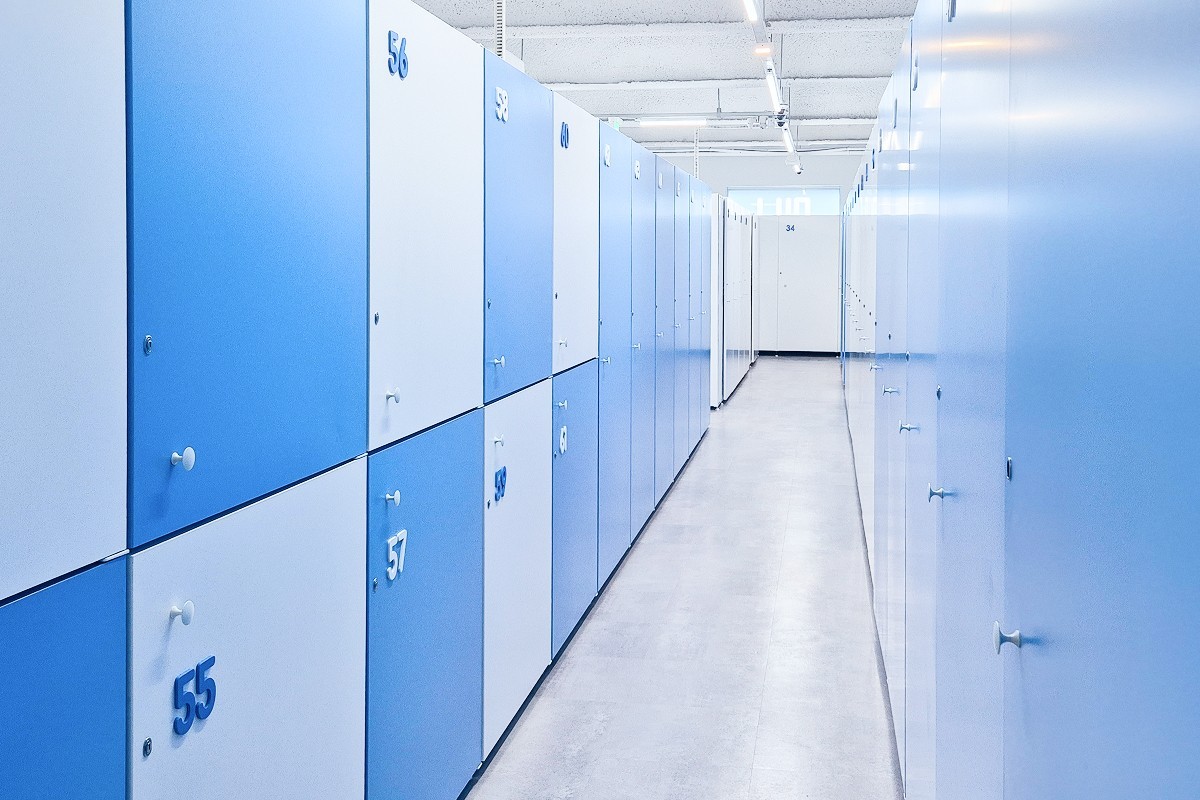
<Mini Warehouse Darak, 100% mobile-app based / Source: Second Syndrome>
Organizing the Concepts of Unmanned and Automation
First, the concepts of unmanned stores and automation can sometimes be used interchangeably, so it would be good to clarify them in advance. In the retail sector, demand for unmanned stores is increasing, and new unmanned operation businesses continue to emerge. Beyond the ice cream shops, convenience stores, stationery stores, laundry rooms, and self-photo studios we already know well, tanning salons, ping-pong halls, workshops, and even bars have recently joined in, and it is expected that almost every retail category will become unmanned.
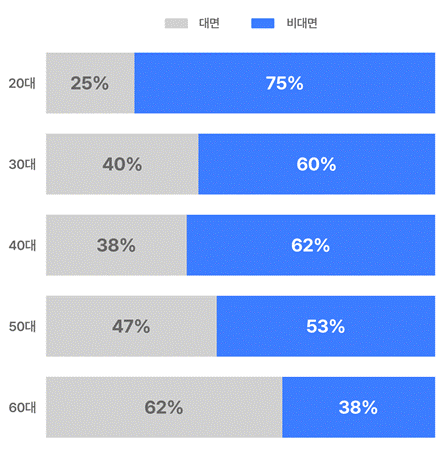
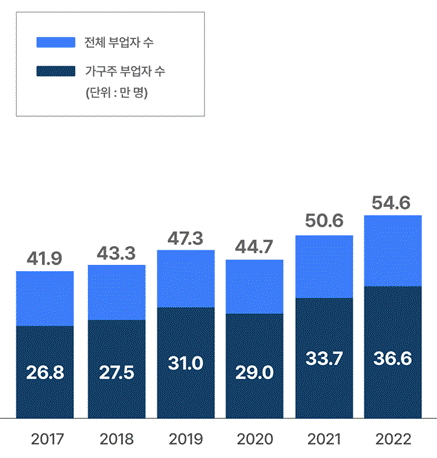
The reason unmanned stores are in the spotlight seems to be a mix of factors: people in their 20s and 30s who went through COVID and prefer non-face-to-face environments, rising labor costs due to the minimum wage increase, and the increase in side-jobbers who want to run so-called “auto stores.” But do these unmanned stores really require no human hands at all?
<Non-face-to-face preference by age group and increase in side jobs / Source: Korea Consumer Agency, FKI>
If you search for unmanned store on Google, what comes up immediately is <unmanned store management service>. If you go in and look, they really do say they manage unmanned stores on your behalf. Wait—didn’t we open an unmanned store so we wouldn’t have to hire people, but now we need to use people again? That’s right. Even in an unmanned store, inventory must be restocked, supplies replenished, machines repaired when they break down, and trash left behind by customers must be cleaned up. In other words, unmanned does not truly mean no people are needed. Either the owner does it, or it is outsourced to a management service.
This is where automation comes in. Automation means not merely that no one is physically present in the store (though someone must appear if needed), but that everything that happens in the store is handled without human intervention. To do that, all operational processes must run automatically online based on scenarios, and even when problems occur, they must be resolvable remotely. Currently, there are almost no industries in Korea where full automation is possible, and in self-storage, Darak is the only one.
Convenience of Automation from the User’s Perspective
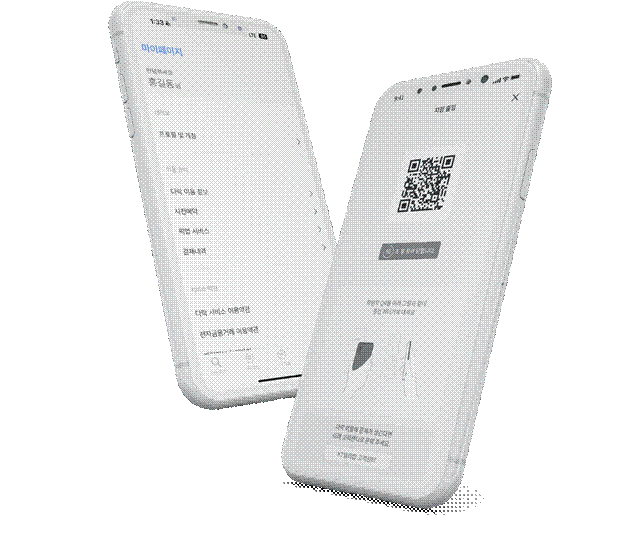
From the user’s point of view, a mobile-app-based system allows free facility tours anytime, 24/7, and lets users start using the service immediately after payment. That means you can browse Darak’s locations at 2 a.m. and start using one right away if you like it. During the usage period, and even when ending the service, all the user has to do is tap on the mobile app. This satisfies the need for non-face-to-face interaction for users storing private belongings.
To provide this kind of convenience, the offline facility must be controllable through the mobile app, and representative examples include security-related devices. Darak jointly developed an integrated security system with Korea’s leading security companies, including S1, and for the security devices of each individual unit, it uses in-house developed devices. What would happen if it used commercially available door locks? Wouldn’t passwords leak, or couldn’t the door be opened through a locksmith? To ensure a seamless user experience, in-house system development is essential.
<Mobile user experience of Mini Warehouse Darak / Source: Second Syndrome>
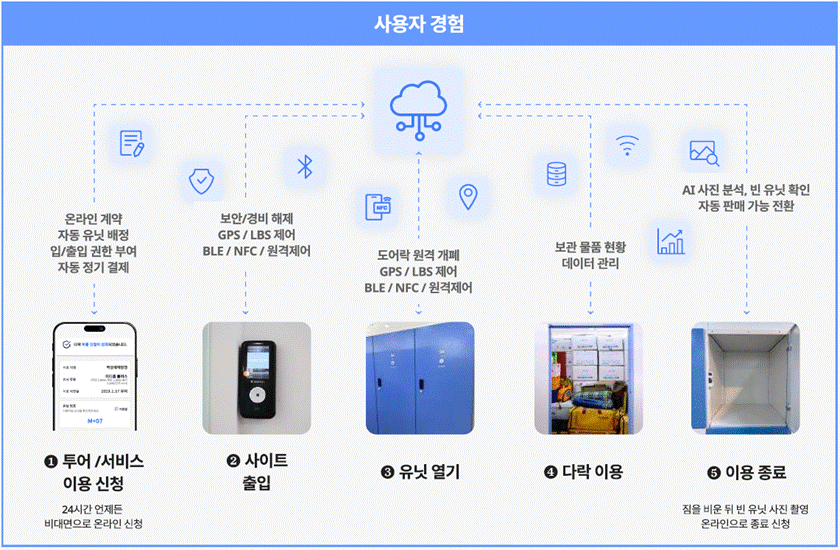
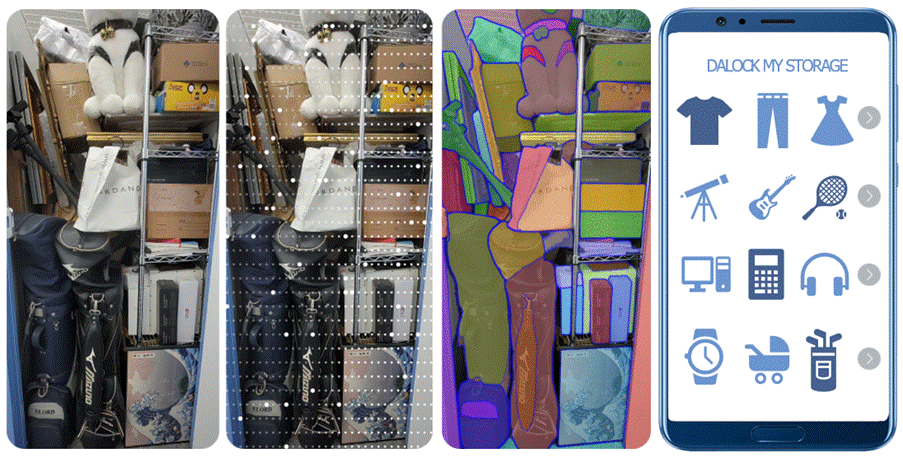
What can happen when a user ends the service? What if someone leaves belongings behind or deliberately abandons them? That too eventually becomes an annoying issue that a person (the owner) has to go and clean up. In this area, Darak is advancing automation by combining photography and AI technology. It is a technology that analyzes photos to determine whether a unit has been left clean and empty. AI technology is being applied in far more areas than just ChatGPT.
Minimizing Operating Costs from the Operator’s Perspective
Operational automation technology also offers very significant benefits to operators. There is no need to hire staff, and the labor costs of building managers or owners also become zero. They can also be free from management costs for running the facility and from various labor-related issues that come with hiring people.
In addition, when storing items, appropriate temperature and humidity must be maintained, accidents must be prevented, and strict security must be upheld. Mini Warehouse Darak senses the environment using IoT sensors and builds an optimal storage environment with accumulated data. The heating, cooling, and humidity-control devices installed inside the facility are linked to four-season scenarios and operate automatically. Of course, if needed, they can also be controlled remotely. The ICT space without boundaries between online and offline has now become standard.
<Mini Warehouse Darak’s H/W and S/W stack / Source: Second Syndrome>
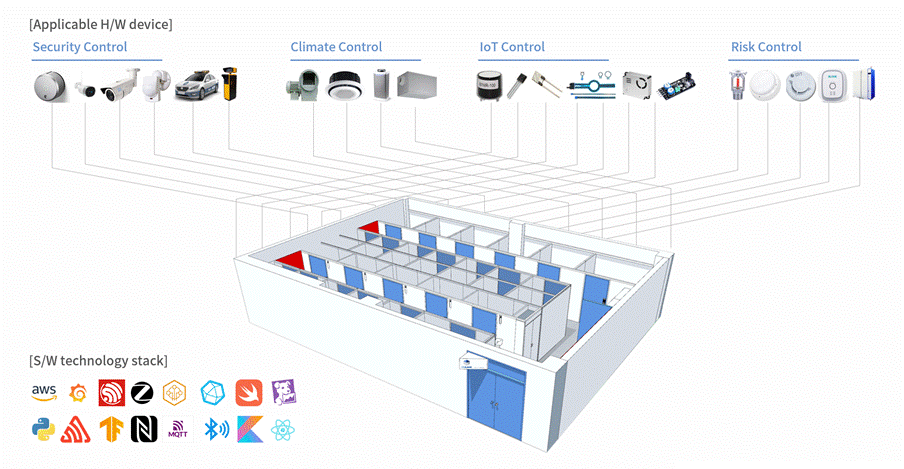
Risk management is also very important, because cracks or pipe leaks can inevitably occur in buildings. Of course, natural disasters such as floods cannot be ignored either. In such cases, the ability to detect leaks in advance through pre-testing is required. At Darak facilities, all offline environments are connected to the system, so when a leak occurs, alarms are triggered to minimize damage. Security also requires features such as entry logs, automatic photography, and emergency dispatch when outsiders enter.
What about sales and marketing? In overseas self-storage businesses, larger companies vary prices by region, and prices change over time like in hotels. Darak also applies a price-change algorithm based on accumulated usage data, and through dynamic pricing, prices change every day. It is a technology that optimizes facility operations by matching supply and demand.
Difficulty of Self-Storage Automation Technology
The Internet of Things (IoT) and information and communications technology (ICT) are no longer unfamiliar concepts to us. But the important thing is how to apply these technologies to real estate content, and if they are not optimized, a reversal will occur in which costs exceed utility. In that sense, technology or hardware developed by an operator who has gone through countless real-world situations is inevitably unmatched, and commercialization through outsourced development is impossible.
Self-storage automation is not a difficult concept, but if applied in reality, the first hurdle is cost. IoT door locks available on the market typically cost 100,000 to 200,000 won each, so even for a small 100-pyeong facility, considering that about 200 locking devices are needed, the cost quickly adds up.
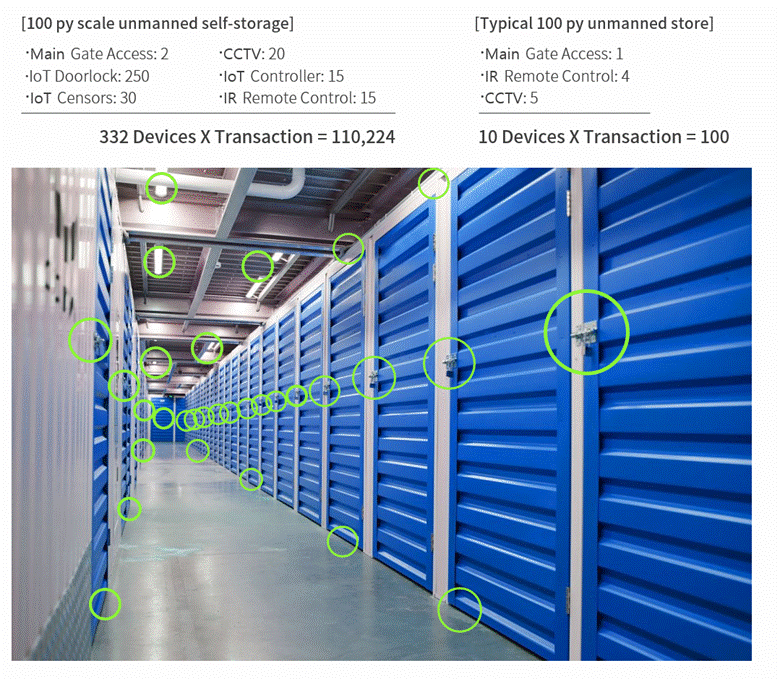
What is even more difficult is the specificity of self-storage facilities. To automate a self-storage facility, it requires more communication devices per unit area than any other industry. In this case, even if the devices only perform simple on/off transactions, the system complexity required is more than 1,000 times greater than in other unmanned businesses. Because such facilities did not exist before, there are no references, and that is why self-storage’s DT (Digital Transform) is delayed even in the global market.
<Complexity of self-storage automation systems / Source: Second Syndrome>
Mini Warehouse Darak currently manages 120 facilities with just 2 people. That is 0.017 people per facility, a number that is incomparable to Public Storage, the global No. 1 company, which has 1.896 people per facility. That is the power of automation technology.
Potential for Reverse Export to the Global Market
From that perspective, it would have been nice if Public Storage had contacted us about a technology partnership, but let’s wait a little longer. Currently, automation technology is first attracting interest in Japan. Japan’s industry emerged 30 years earlier than Korea’s, and its market size reaches 1 trillion won, so there seems to be plenty of room for Darak’s automation technology to be applied. Japan also shares similarities with Korea in population structure, and cost-cutting issues such as real estate rent and labor costs coexist there as well.
What matters is that although Korea started later than other countries, Mini Warehouse Darak is at the global top level in technology. Darak has already gone beyond automation and is now challenging the screening of stored items by equipping its system with Vision AI technology. Japanese companies have been visiting Korea one after another, so industrial exchange between the two countries seems certain in some form. Like other Korean Wave phenomena, we may soon see K-Storage on the global stage.
In the next article, we will turn our attention back to Korea and look at domestic real estate sectors that urgently need the introduction of this kind of operational automation technology and self-storage.
<Diagram of Darak’s Vision AI application / Source: Second Syndrome>