insight

Hong Woo-tae, the representative of DaLock
2025 will be an important turning point for the domestic self-storage industry and Mini Storage DaLock. The recent inclusion of the self-storage sector in the National Pension Service’s real estate core platform fund investment targets shows that this industry is beginning to establish itself as a major investment sector, moving beyond a simple space-rental service. In this article, we will look at the differentiation strategies being pursued by overseas self-storage companies and talk about the limitless scalability of self-storage.
United States: Startup-led UX innovation
In the United States, the world’s oldest and largest self-storage market, efforts to attract millennial customers are actively underway. Moving beyond a purely 'value-for-money' approach, services are shifting toward the convenience and comfort preferred by younger consumers. What is especially noteworthy is that this innovation is being driven not by established giants such as Public Storage or Extra Space, but by startups that emerged relatively recently.
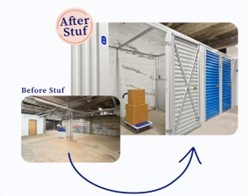
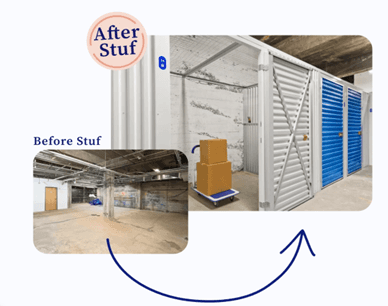
U.S. self-storage has mainly expanded from large warehouse facilities located in the suburbs to facilities in urban centers, and recently a new approach has emerged: converting vacant buildings in city centers into storage. One company leading this trend is Stuf, a self-storage startup founded in 2020.
This startup is rapidly expanding in major cities such as New York, Los Angeles, and Seattle, and has become very popular among young consumers thanks to its clean, bright, modern facility design and excellent accessibility. In particular, it showcases cases of converting repurposed lodging facilities and cultural venues into self-storage, which is in line with DaLock’s conversion of bus terminals and movie theater spaces into self-storage.
Stuf also does not follow the traditional real estate ownership model, instead adopting a model in which operating revenue is shared with property owners. Thanks to this model, Stuf boasts rapid scalability, being able to open a new location in just 2 to 3 weeks. This innovative business model has raised a $11 million Series A investment from Altos Ventures and Allegion Ventures, both well known in Korea, proving the potential of a new self-storage model.
This is also the same approach that DaLock applied to domestic site expansion until last year. From its early days, DaLock viewed the core of storage usage as 'accessibility' and expanded its sites around vacant spaces in urban areas close to residential neighborhoods. While sharing revenue with building owners facing vacancy issues, it has also built facilities integrated with residential buildings. Through this, DaLock has not only grown at the fastest pace in Korea, but has also become a strong alternative for real estate assets suffering from prolonged vacancies.
< Stuf’s urban vacant-space storage conversion case / Source: Stuf >

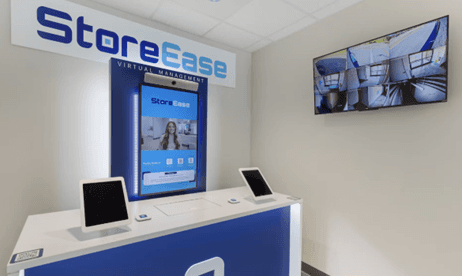
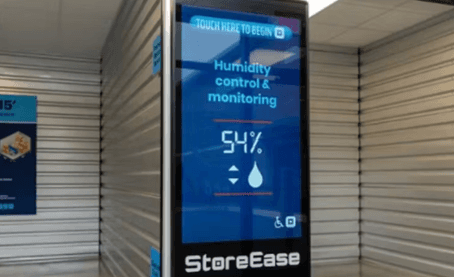
Another noteworthy startup is Store Ease, founded in 2019. Store Ease provides an innovative storage experience through a virtual management platform powered by artificial intelligence (AI). Key technologies include the 'Virtual Managers' system, which remotely manages multiple facilities, and 'Climate Controlled Storage,' which applies various sensors and IoT technologies. Through these technologies, customers can use services conveniently without staff stationed on-site, while maintaining a comfortable storage environment.
In fact, when it comes to automation technologies using AI, DaLock has had it in its DNA from the very beginning. DaLock’s automation technology, which enables complete 24/7 use and operation without human intervention, has been applied to all 150 domestic sites, improving building operational efficiency. DaLock’s environmental management system, which manages 150 sites with just three people around the clock, builds the best possible operation environment with minimal operating costs.
What we can learn from the changes in the United States is that demand for self-storage facilities is no longer dependent solely on price, and the importance of user experience is steadily increasing. This is the part that Second Syndrome values most, and it is also the core capability that has enabled Mini Storage DaLock to expand sites and customers faster than anyone else in Korea.
< Store Ease’s technology-based storage infrastructure / Source: Store Ease >
United Kingdom: Providing a variety of value-added services to attract corporate customers
Next, let’s look at the UK as a representative case in Europe. The UK is ahead of Korea in population (68 million) and GDP per capita ($52,000), and its urbanization rate is 83.9%, similar to Korea’s 81.8%. It also shares similarities with Korea in that, after experiencing one of the fastest industrializations in the world, its economy is now centered on knowledge industries and services.
The UK self-storage market began to grow in earnest in the 1990s, and as of 2024 its market size reached approximately EUR 1.08 billion (KRW 1.61 trillion). Centered on Safe Store (180 sites) and Big Yellow (150 sites), about 1,700 sites are operating nationwide, and each facility ranges in size from 2,000 to 3,000 pyeong.
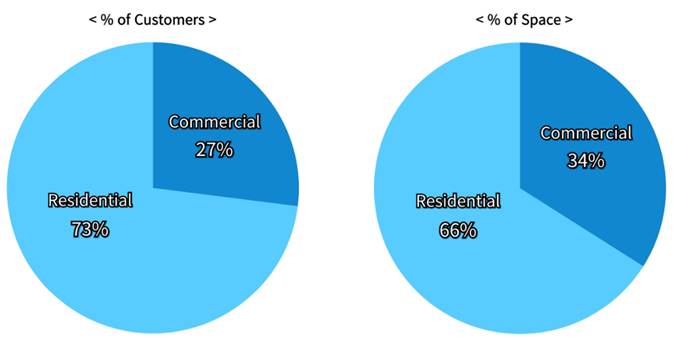
The Annual Report published every year by the Self Storage Association UK (SSA UK) includes surveys on the current state of the UK self-storage market and user perceptions. According to this report, corporate customers account for 27% of all self-storage customers in the UK, a significantly higher share compared to Korea. Corporations not only use larger storage spaces per customer than individuals, but also show a higher rate of long-term use.
< Status of UK self-storage customer types / Source: Self Storage Annual Report 20241 (SSA UK) >
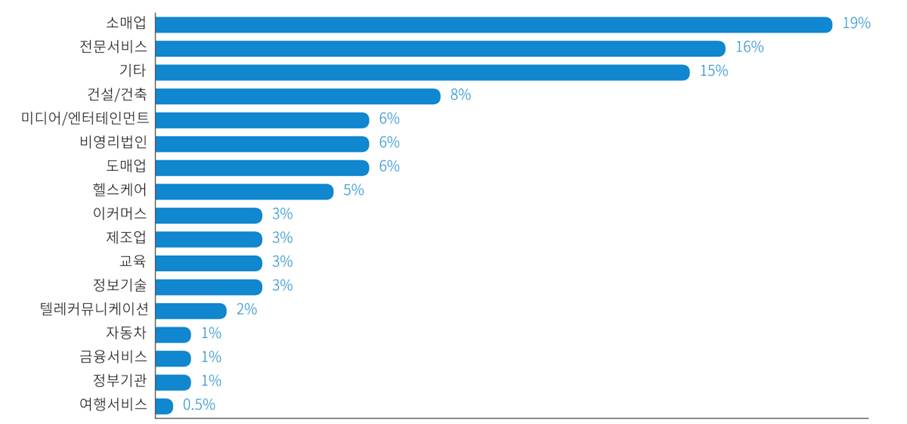
< Status of UK self-storage corporate customer industries / Source: Self Storage Annual Report 20241 (SSA UK) >
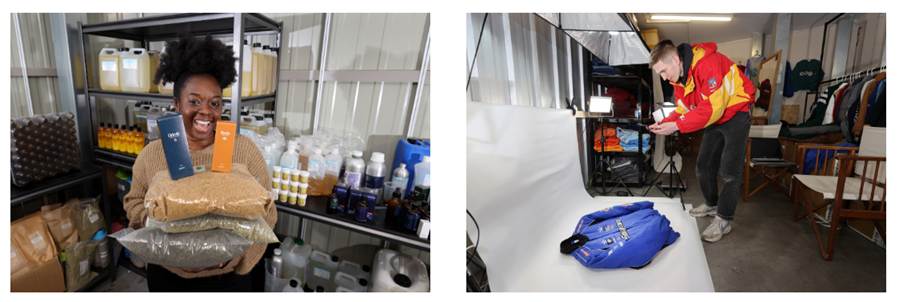
UK self-storage companies also provide a variety of value-added services to attract corporate customers. In particular, they support smoother business operations by offering not only inventory management and document storage, but also tax and logistics services. Some companies act on behalf of customers to manage and distribute specific items they need, increasing inventory management efficiency through stock-level monitoring and real-time data updates.
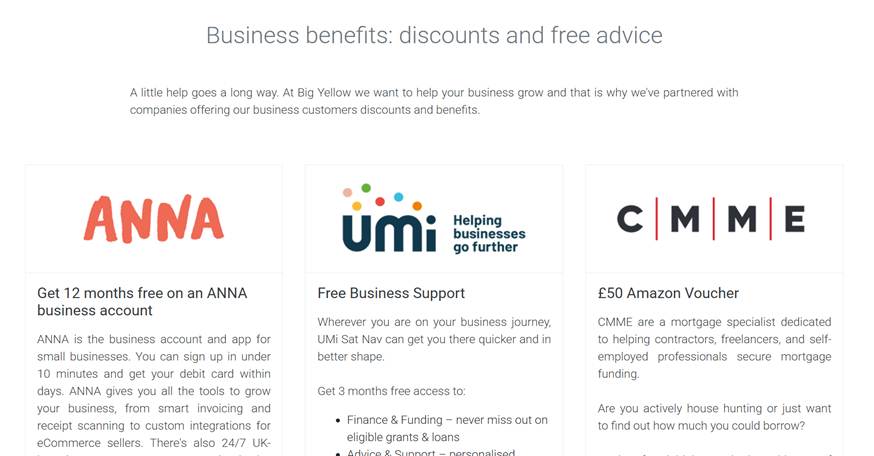
Customized services for startups are also being actively provided. For example, Big Yellow and Safe Store go beyond simply offering warehouses as storage space to startup customers; they also provide tax filing and consulting services needed for business growth, helping them from the early stages of founding through expansion. In this way, self-storage companies integrate a wide range of services for corporate customers and play a major role in improving overall business efficiency.
Currently, about 20% of DaLock’s business customers are business operators, and this is expected to increase further in the future. The main needs are storing documents that must be kept for a mandated period, and quickly sourcing raw materials, inventory, and samples within the city. Also, as the era of solo entrepreneurs centered on social media begins in earnest, demand for self-storage from commerce operators who are not yet ready to use fulfillment services is increasing. Solo entrepreneurs cannot easily stack products at home, but at the same time, expanding to the stage where they use fulfillment is somewhat limited, so we expect this to continue forming a steady demand base.
< Services provided by UK Business Storage / Source: Big Yellow) >
Japan: A premium strategy to deliver differentiated value
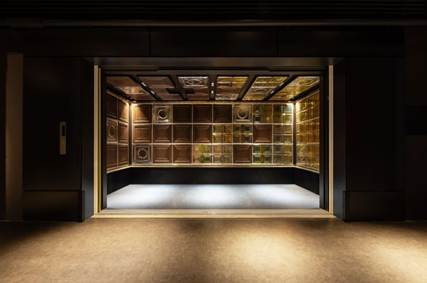
In Japan, where the self-storage industry is the most widely adopted in Asia, innovative changes are also taking place. One of the leaders is 'Warehouse TERRADA.' Warehouse TERRADA is a company with 70 years of history, having started as a grain warehouse in the Tennōzu area of Tokyo in October 1950. However, amid fierce competition, it is pursuing a premium strategy optimized for storing high-value items in order to differentiate itself.
Based on the philosophy that “Culture Calls For Creation,” Warehouse TERRADA is reconfiguring self-storage as a space that preserves and creates cultural value. Its main target customers are affluent individuals with sophisticated hobbies, who own collectibles such as expensive artworks, jewelry, and wine that require special storage conditions.
Warehouse TERRADA provides a space that can safely store these customers’ “objects of cultural value” and further enhance their worth. To do this, it offers luxurious storage environments equipped with temperature and humidity control systems, which are rare in Japan.
In addition, Warehouse TERRADA operates an exhibition space called the 'WHAT Museum,' providing a place where customers can display their stored artworks to the public. This not only increases the value of customers’ assets but also gives the general public an opportunity to appreciate art.
DaLock also signed a business agreement in 2022 with Tycoon P&H, the operator of 'The Seoul Lightium,' Korea’s largest private complex cultural exhibition hall, and has been making efforts to support local arts and culture. By opening a DaLock location in Galleria Forêt in Seongdong-gu, Seoul, it has been providing space where artworks, sculptures, and other exhibition items, as well as materials needed for concerts and theater preparation, can be stored.
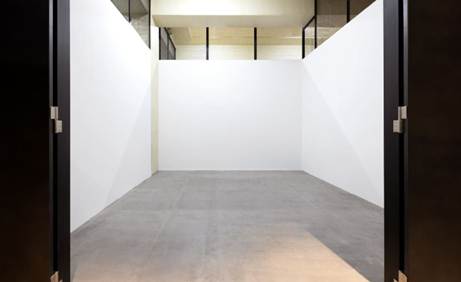
< Terrada Art Storage / Source: Warehouse Terrada>
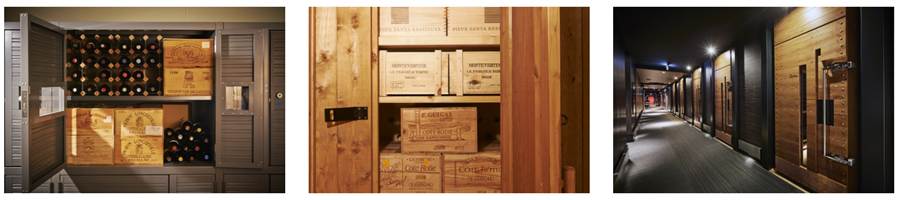
In addition, through the 'TERRADA Wine' service, it provides storage and management services for premium wine. It goes beyond simply offering space to store wine, and also provides various value-added services that use digital technology to manage customers’ wine information and increase investment value.
< Terrada Wine Storage / Source: Warehouse Terrada >
As the number of DaLock users increases and a larger customer base is secured, inquiries about introducing warehouse facilities for specialized items such as artworks and wine have continued. The storage environment currently operated by DaLock is at a level that is very suitable for storing artwork and wine, so in the future, such specialized DaLock self-storage may well emerge. Above all, it is likely to reflect DaLock’s values, which prioritize user experience and customer convenience across both online and offline channels rather than simply building facilities.
Implications for the Korean self-storage market
The implications of the overseas cases we have examined so far are that even in mature markets, differentiation is possible through customized strategies. Since self-storage is not limited to simply storing individuals’ belongings, it can provide a wide range of value tailored to customer needs beyond its basic function. Moreover, as proof of this, even the U.S. market, which is considered mature, continues to show mid-3% annual growth, confirming that self-storage growth follows a long cycle.
Going forward, demand for global self-storage is expected to be influenced not just by price competition but increasingly by customer experience and specialized services. In this context, it is very encouraging that DaLock’s services and technology are ahead of those of any existing global self-storage operator. Not only facility automation technology, but also the digitization of customers’ stored items using DaLock Vision AI technology will be an unprecedented innovation in the global self-storage market.
In addition, as seismic shifts in Korea’s real estate market are bringing more attention to self-storage, it seems that the day when the world’s first building-level large-scale self-storage facility with automation technology will appear in Korea is not far off. We will continue to share DaLock’s activities in Korea’s self-storage market, which is expected to be hotter than ever in 2025.


